Vol. I · The open image paperWinnipeg · Musée sans mursRecovered · Remembered · Returned
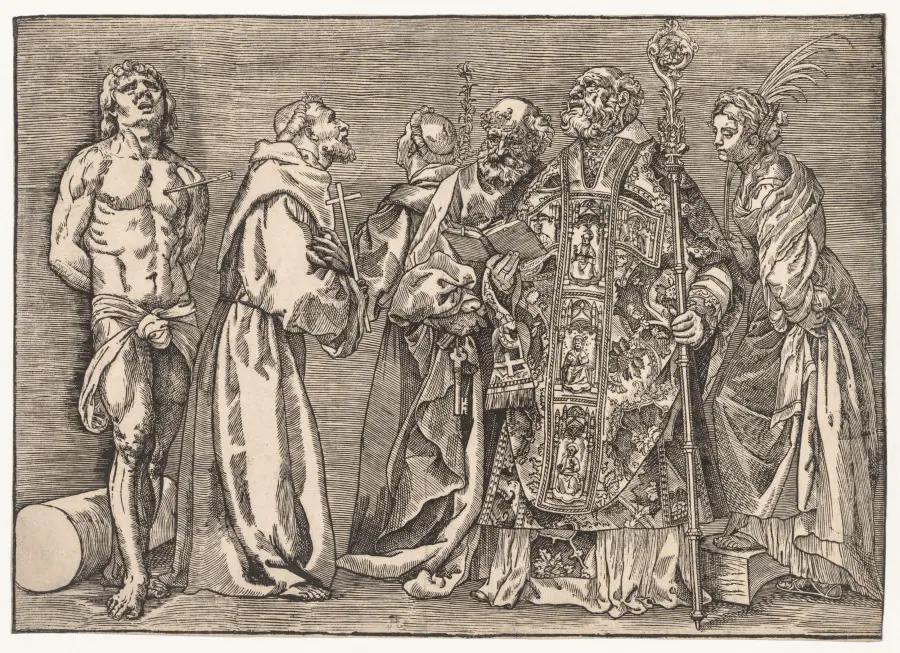
Cleveland Museum of Art141724landscapeNiccolo Boldrini (Italian, c. 1500–after 1566)c. 1535CC0cma sacred-art portraits design-assets ink-paper-impressions objects-with-gravity sacred art design assets ink paper impressions objects with gravity engraving religious christian holy family saints monk hierarchical durer renaissance woodcut black and white grave serious detailed portrait medieval 16th century the sixNiccolo Boldrini (Italian, c. 1500–after 1566) c. 1535 Italy, Venice woodcut Print European ReligiousSacred & Devotional Faces in Time The Maker’s Cabinet Ink, Paper & Impressions Objects with Gravity
Practical reuse
Use this artwork.
Verified CC0
This record carries an explicit CC0 marker in the source metadata. Download the publication copy or follow the source record for its master image.
The Six Saints by Niccolo Boldrini (Italian, c. 1500–after 1566) (c. 1535). Gift of The Print Club of Cleveland Rights: CC0. https://clevelandart.org/art/1965.307
Vault de Lupin makes the source signal legible; it does not provide legal advice or replace the institution’s current rights statement.
From the museum record
At first, Titian utilized woodcut as a medium of direct expression. He most probably drew directly on the blocks for The Submersion of Pharaoh's Army in the Red Sea and prepared several drawings for each landscape print, carefully perfecting the compositions. After 1530, however, Titian no longer created new designs expressly for graphic reproduction. Rather, prints were a means of circulating pictorial ideals conceived for and executed initially in painting. The Six Saints records, in reverse, the group of saints—Sebastian, Francis, Anthony of Padua, Peter, Nicholas, and Catherine—standing below the vision of the Madonna and Child in Titian's altarpiece for the Venetian church of Saint Nicolo ai Frari. Because the print reproduces only the lower section of the picture, the monumentality of the original conception is diminished, but an image of greater intimacy is gained. Here, Titian changed the figure of Sebastian, whose pose in the original is ungainly. In the print, Sebastian's body is more clearly articulated and, looking heavenward, his face is filled with a stoic pathos.
Lupin’s visual index
This engraving depicts a solemn religious scene featuring Christ, a Franciscan monk, and several saints in a formal, hierarchical arrangement.
Machine-assisted description · useful for discovery, not scholarship.