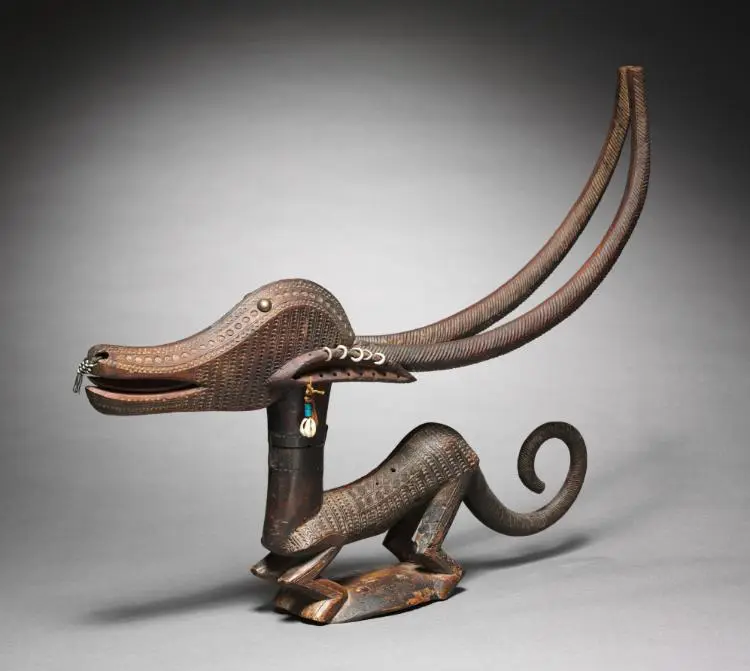
Headdress (chi wara)
Practical reuse

Use this artwork.

Verified CC0

This record carries an explicit open-use marker in the source metadata. Download the publication copy or follow the museum record for its master image.

Download publication WebP Open museum master ↗
Rights signal
CC0
Publication file
750 × 671 px · WebP
Suggested credit
Headdress (chi wara) (early to mid-1900s). Gift of Mrs. Ralph M. Coe in memory of Ralph M. Coe Rights: CC0. https://clevelandart.org/art/1965.325

Vault de Lupin makes the source signal legible; it does not provide legal advice or replace the institution’s current rights statement.

From the museum record

Chi wara —a mythical “farming beast”—was said to teach farming to the Bamana people. Carved patterns cover this female chi wara’s body, highlighting its muscles and emphasizing that it is no earthly animal, but rather an agricultural spirit that combines human, antelope, and anteater elements. This example wears earrings and a nose ring of imported metals and beads. Its carver—a blacksmith—used a naturalistic style common south of the city of Bamako. Accompanied by women’s songs, male performers danced paired male-and-female chi wara headdresses affixed to basketry caps at agricultural competitions and weddings.

Lupin’s visual index

A stylized bronze sculpture depicts a bull with exaggerated horns and intricate detailing, characteristic of West African art.

Machine-assisted description · useful for discovery, not scholarship.
Continue looking

Nearby in the vault.

Headdress (chi wara)

Headdress (chi wara)

Your private shortlist

Saved works 0

Stored only in this browser. No account, tracking, or upload.

No works saved yet.

Use “Save work” on any catalogue card or artwork record to build a working collection.