Vol. I · The open image paperWinnipeg · Musée sans mursRecovered · Remembered · Returned
Cleveland Museum of Art123965portraitGiovanni Battista Tiepolo (Italian, 1696–1770)c. 1740CC0cma mythology landscapes design-assets ink-paper-impressions night-dreams design assets ink paper impressions night dreams drawing sketch monochrome brown tones figure people architecture allegory classical italian 18th century sketching brown beige shadows composition seated narrative the adoration magiGiovanni Battista Tiepolo (Italian, 1696–1770) c. 1740 Italy, Venice pen and brown ink and brush and brown wash, over black chalk, [object Object] Drawing European MythologicalMyth & Metamorphosis Horizons & Places The Maker’s Cabinet Ink, Paper & Impressions Night, Dreams & Apparitions
Practical reuse
Use this artwork.
Verified CC0
This record carries an explicit CC0 marker in the source metadata. Download the publication copy or follow the source record for its master image.
The Adoration of the Magi by Giovanni Battista Tiepolo (Italian, 1696–1770) (c. 1740). Dudley P. Allen Fund Rights: CC0. https://clevelandart.org/art/1944.474
Vault de Lupin makes the source signal legible; it does not provide legal advice or replace the institution’s current rights statement.
From the museum record
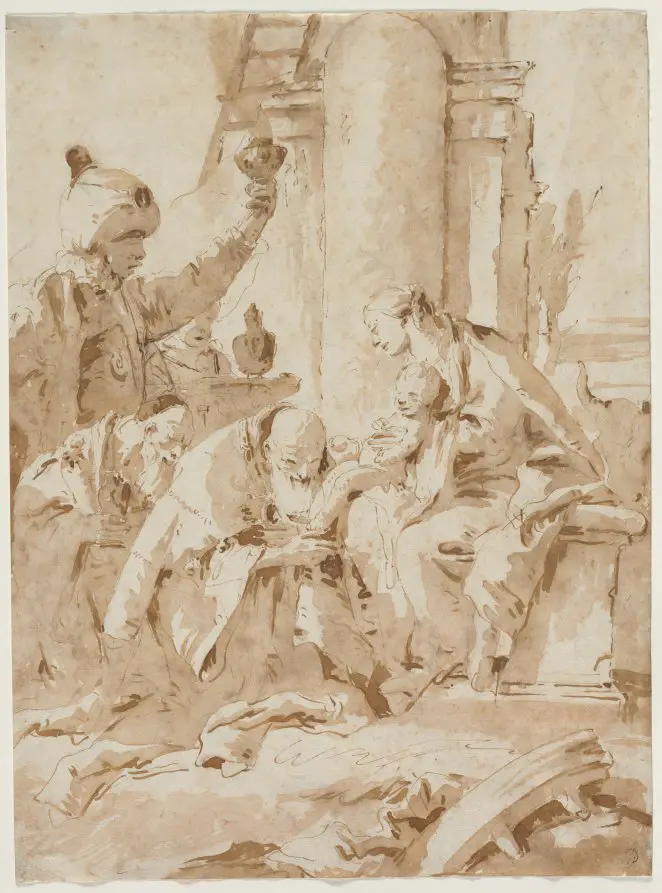
According to the Gospel of Matthew, three Magi, guided by a star, found the newborn Jesus and laid gifts of gold, frankincense, and myrrh before him. Giovanni Battista (Giambattista) Tiepolo’s drawing of the traditional subject places the Madonna on a platform as she holds the Christ child out toward three approaching magi. Two bearded white magi kneel in supplication as the turbaned black magi stands behind them. Tiepolo plays with the conventions of the Adoration subject by employing an asymmetrical composition. Working over his black chalk underdrawing, traces of which are visible in the figures’ robes, the artist delineated the scene with brown ink, quill pen, and brush before modeling with brown wash. Tiepolo’s mastery over value is evident in his contrasts of dark shadow with light midtones and the luminous white of his paper, producing his celebrated effects of glistening sunlight and clear atmosphere. The broken wheel in the foreground, an attribute of Saint Catherine, also appears in Tiepolo's etching of the same subject (1965.18) to which this drawing may be related.
Lupin’s visual index
A monochromatic drawing depicts a group of figures, including a man and woman, seated amidst a draped cloth and architectural elements, suggesting a narrative scene.
Machine-assisted description · useful for discovery, not scholarship.