Vol. I · The open image paperWinnipeg · Musée sans mursRecovered · Remembered · Returned
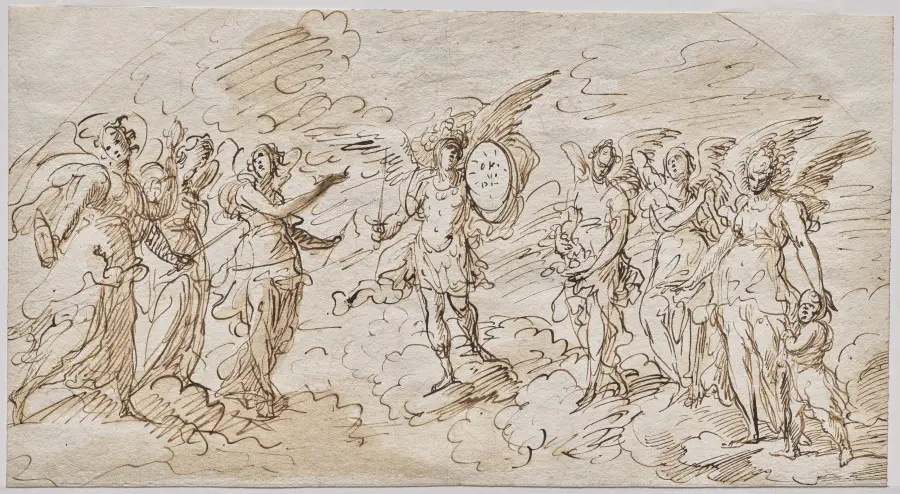
Cleveland Museum of Art693409landscapeMassimo Stanzione (Italian, 1585–1656)c. 1620sCC0cma sacred-art mythology design-assets ink-paper-impressions sacred art design assets ink paper impressions angels drawing sketch etching pen and ink classical allegory divine heaven clouds light serene renaissance italian ornate detailed figure drawing the seven archangels rectoMassimo Stanzione (Italian, 1585–1656) c. 1620s Italy Pen and brown ink, brown wash, traces of black chalk (recto) Drawing European ReligiousSacred & Devotional Myth & Metamorphosis The Maker’s Cabinet Ink, Paper & Impressions
Practical reuse
Use this artwork.
Verified CC0
This record carries an explicit CC0 marker in the source metadata. Download the publication copy or follow the source record for its master image.
The Seven Archangels (recto) by Massimo Stanzione (Italian, 1585–1656) (c. 1620s). Purchase from the J. H. Wade Fund Rights: CC0. https://clevelandart.org/art/2025.132.a
Vault de Lupin makes the source signal legible; it does not provide legal advice or replace the institution’s current rights statement.
From the museum record
Massimo Stanzione worked in the Spanish-held Kingdom of Naples, where, during the 17th century, painting was characterized by dramatic expression, emphatic naturalism, and intense chiaroscuro derived from the profound influence of Caravaggio (1571-1610). Stanzione, however, was known in the city as one of the main purveyors of a more classical style, a kind of antithesis to the passion and drama of such Neapolitan painters as Jusepe de Ribera. This drawing relates directly to a painting Stanzione made depicting the seven archangels at the Monasterio de la Descalzas Reales in Madrid. The iconography of the seven archangels was a regional focus of devotion in the Neapolitan kingdom, and in Spain, where the cult of the “Seven Angelic Princes” had been promoted by the 16th-century Sicilian friar, Antonio Del Duca (1491-1564).
Lupin’s visual index
A monochromatic drawing depicts six winged figures ascending through swirling clouds, suggesting a divine or allegorical narrative.
Machine-assisted description · useful for discovery, not scholarship.