Vol. I · The open image paperWinnipeg · Musée sans mursRecovered · Remembered · Returned
Cleveland Museum of Art117767landscapeGiovanni Battista Piazzetta (Italian, 1682–1754)1723–27CC0cma sacred-art portraits design-assets ink-paper-impressions sacred art design assets ink paper impressions sketch charcoal angel wings drawing study gesture anatomy classical renaissance draftsmanship figure composition grey brown old flying recto studies hands playing instruments versoGiovanni Battista Piazzetta (Italian, 1682–1754) 1723–27 Italy, Venice black chalk heightened with traces of white chalk Drawing European ReligiousSacred & Devotional Faces in Time The Maker’s Cabinet Ink, Paper & Impressions
Practical reuse
Use this artwork.
Verified CC0
This record carries an explicit CC0 marker in the source metadata. Download the publication copy or follow the source record for its master image.
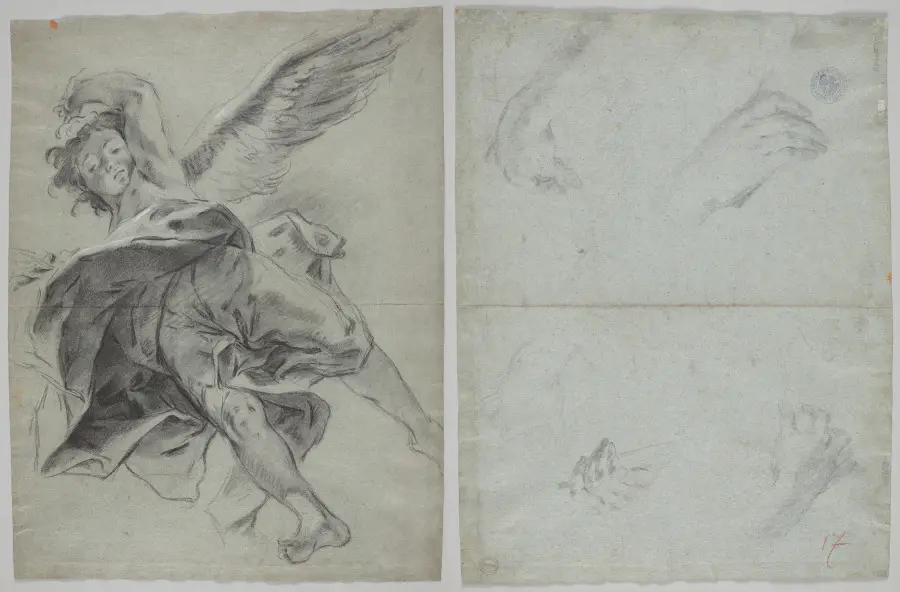
A Flying Angel (recto); Studies of Hands Playing Instruments (verso) by Giovanni Battista Piazzetta (Italian, 1682–1754) (1723–27). Purchase from the J. H. Wade Fund Rights: CC0. https://clevelandart.org/art/1938.388
Vault de Lupin makes the source signal legible; it does not provide legal advice or replace the institution’s current rights statement.
From the museum record
This drawing was completed in preparation for the most prestigious religious commission of Giovanni Battista Piazzetta’s career, the ceiling painting of the Glory of St. Dominic for the church of SS. Giovanni e Paolo in Venice. Both the finished painting, which depicts St. Dominic’s arrival in heaven amid a thundery vortex, and Piazzetta’s study for the angel, who carries St. Dominic on a cloud, depart from Venetian tradition. To execute this airborne subject, he likely drew from wax or clay models suspended in midair in order to study the illusionistic di sotto in su (from below to above) perspective and the play of light found on the angel’s shadowed form. He worked out the angel’s twisting pose, imbuing it with a lively sense of movement, and accentuated the drapery’s folds with heavy lines as though considering their visibility from afar. There are only slight changes in the angel’s pose between this drawing and the completed painting. As few of Piazzetta’s preparatory studies for paintings exist, Cleveland’s sheet offers rare insight to the artist’s working methods.
Lupin’s visual index
A detailed charcoal sketch depicts a dynamic angel in motion, alongside studies of hands and drapery.
Machine-assisted description · useful for discovery, not scholarship.