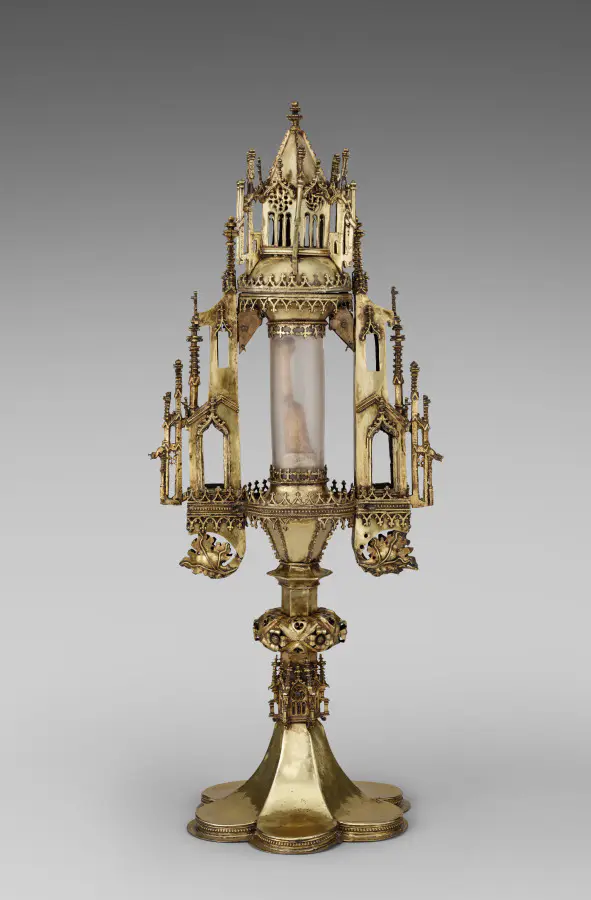
Monstrance with a Relic of Saint Sebastian
Practical reuse

Use this artwork.

Verified CC0

This record carries an explicit open-use marker in the source metadata. Download the publication copy or follow the museum record for its master image.

Download publication WebP Open museum master ↗
Rights signal
CC0
Publication file
591 × 900 px · WebP
Suggested credit
Monstrance with a Relic of Saint Sebastian (1484). Gift of Julius F. Goldschmidt, Z. M. Hackenbroch, and J. Rosenbaum in memory of the Exhibition of the Guelph Treasure held in the Cleveland Museum of Art from 10 January to 1 February 1931 Rights: CC0. https://clevelandart.org/art/1931.65

Vault de Lupin makes the source signal legible; it does not provide legal advice or replace the institution’s current rights statement.

From the museum record

This Late Gothic monstrance (from the Latin monstrare, "to show") is mentioned in the earliest inventory of Saint Blaise as "a large new monstrance containing relics of Saint Sebastian the martyr." Judging from surviving receipts, the reliquary was made by Werner Korff, a local goldsmith, who received payments for silver and gilding at the end of 1484. The reliquary was first displayed on the altar of the church of Saint Blaise in a solemn penitential mass on June 4, 1484, in an effort to ward off the plague. A recent examination revealed that the relic is a human metatarsal bone (one of five long bones of the human foot) and that its owner seemed to have suffered from periostitis, a medical condition that affects the connective tissue surrounding the bone.

Lupin’s visual index

A gilded reliquary displays a fragment of cloth believed to be associated with Saint Benedict, featuring intricate Gothic detailing.

Machine-assisted description · useful for discovery, not scholarship.
Continue looking

Nearby in the vault.

Monstrance with a Relic of Saint Sebastian

Monstrance with a Relic of Saint Sebastian

Your private shortlist

Saved works 0

Stored only in this browser. No account, tracking, or upload.

No works saved yet.

Use “Save work” on any catalogue card or artwork record to build a working collection.