Practical reuse
Use this artwork.
Verified CC0 This record carries an explicit CC0 marker in the source metadata. Download the publication copy or follow the source record for its master image.
- Rights signal
- CC0
- Publication file
- 756 × 893 px · WebP
- Suggested credit
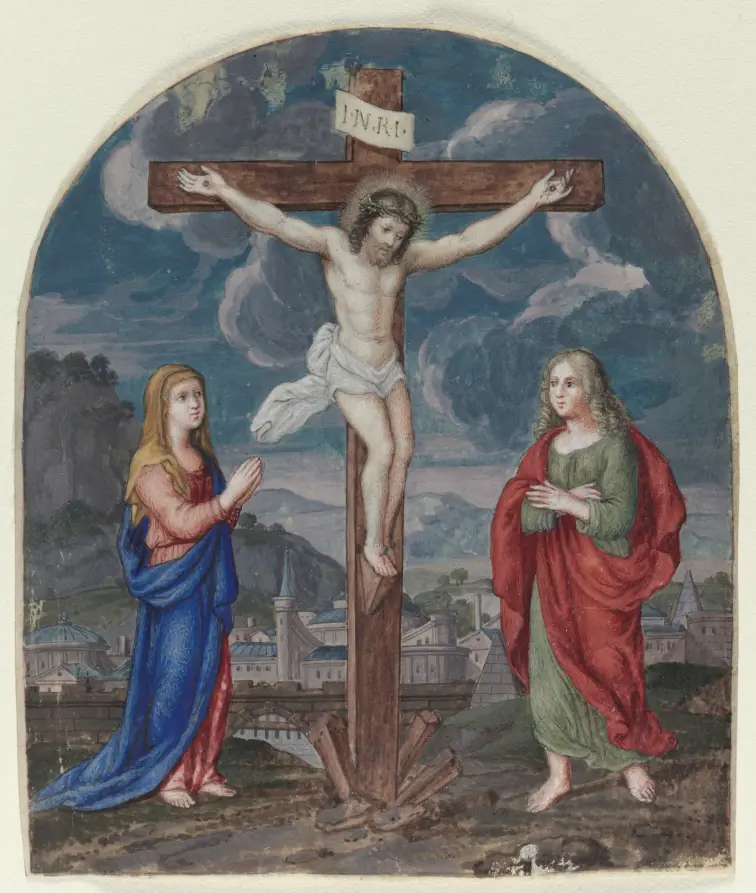
- The Crucifixion: Miniature Excised from a Prayer Book (c. 1540–1550). Gift of Mrs. Henry A. Everett for the Dorothy Burnham Everett Memorial Collection Rights: CC0. https://clevelandart.org/art/1932.135
Vault de Lupin makes the source signal legible; it does not provide legal advice or replace the institution’s current rights statement.
From the museum record
The illuminator is unknown, but his style seems to conform to that known as "Antwerp Mannerism." It emerged among a group of Antwerp painters during the first half of the 1500s. Bolstered by its rich trade and cultural contacts, the port city of Antwerp attracted hundreds of artists-many of them from northern France, the Rhineland, and especially Holland-who joined the local painters’ Guild of Saint Luke, established large painting and sculpture workshops, and fed an expanding market for the production and export of art. Though stylistic traits differed from artist to artist, some defining features of Antwerp Mannerist painting are dramatic gestures, figural arrangements, lavish costumes, vivid, sometimes abrasive coloristic effects, imaginative architecture that freely combines Gothic and Renaissance elements, and demonstrative technical virtuosity
Lupin’s visual index
a devotional painting depicts christ crucified with his mother mary and john the evangelist observing the scene.
Machine-assisted description · useful for discovery, not scholarship.