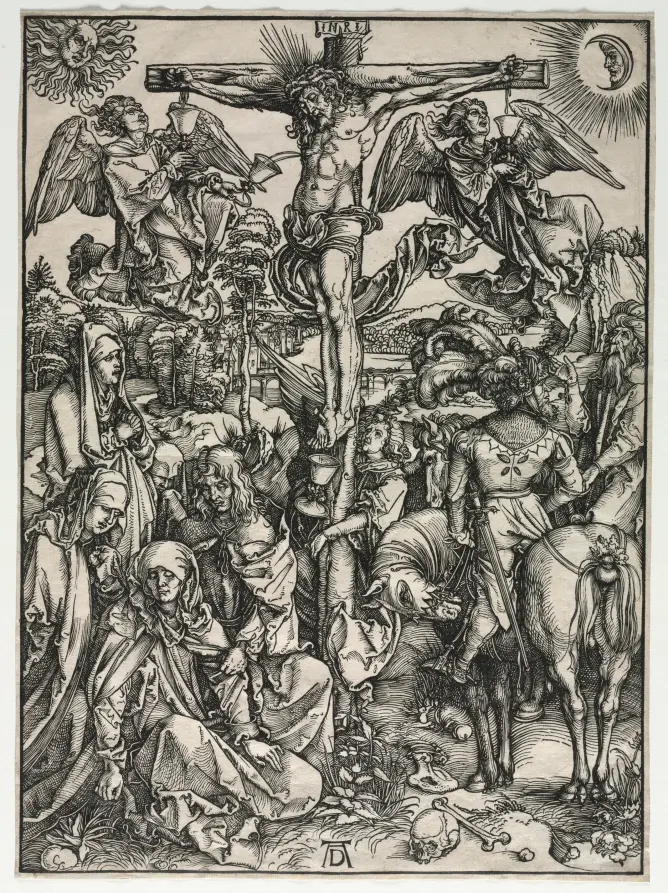
The Large Passion: The Crucifixion
Practical reuse

Use this artwork.

Verified CC0

This record carries an explicit open-use marker in the source metadata. Download the publication copy or follow the museum record for its master image.

Download publication WebP Open museum master ↗
Rights signal
CC0
Publication file
668 × 893 px · WebP
Suggested credit
The Large Passion: The Crucifixion by Albrecht Dürer (German, 1471–1528) (c. 1497–1500). Gift of The Print Club of Cleveland in memory of Ralph King Rights: CC0. https://clevelandart.org/art/1926.118

Vault de Lupin makes the source signal legible; it does not provide legal advice or replace the institution’s current rights statement.

From the museum record

Dürer made seven of the twelve woodcuts for The Large Passion between 1497 and 1500 and then produced four additional woodcuts in 1510. The following year he published the series in book form with a frontispiece and Latin verses composed by Benedict Schwalbe. The Nuremberg monk and poet's text was printed on the back of the sheets. At the same time, Dürer printed a second edition of The Apocalypse and the first edition of The Life of the Virgin . The scenes of The Large Passion executed between 1497 and 1500 retain certain Gothic conventions: a wealth of detail; two-dimensional, awkward figures; ambiguous picture space; and confusing compositions. However, the strong contrast between the thick, black, expressive lines and the white paper creates a vitality lost in the prints from 1510, when Dürer's style changed dramatically.

Lupin’s visual index

this engraving depicts the crucifixion of jesus christ with angels, mourners, and symbolic figures surrounding the cross.

Machine-assisted description · useful for discovery, not scholarship.
Continue looking

Nearby in the vault.

The Large Passion: The Crucifixion

The Large Passion: The Crucifixion · Albrecht Dürer (German, 1471–1528)

Your private shortlist

Saved works 0

Stored only in this browser. No account, tracking, or upload.

No works saved yet.

Use “Save work” on any catalogue card or artwork record to build a working collection.