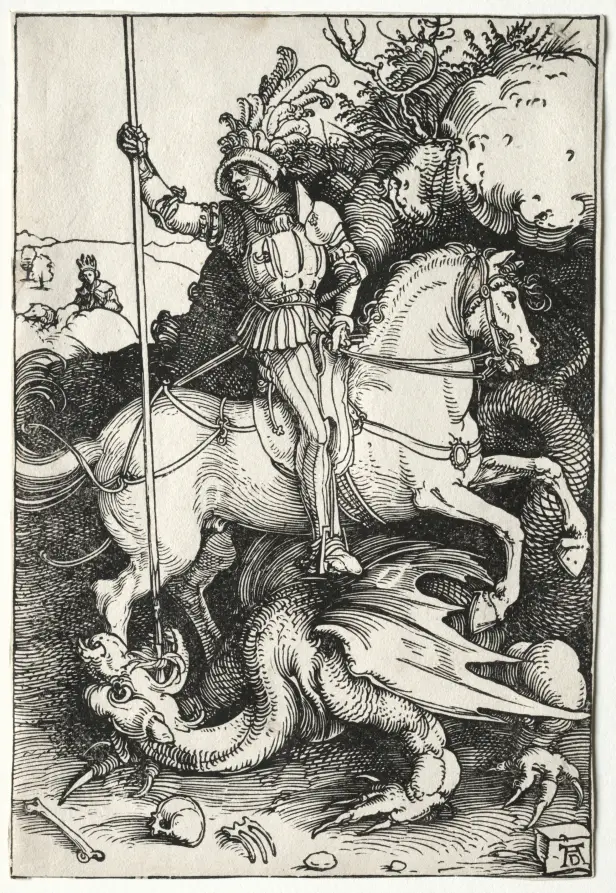
St. George Killing the Dragon
Practical reuse

Use this artwork.

Verified CC0

This record carries an explicit open-use marker in the source metadata. Download the publication copy or follow the museum record for its master image.

Download publication WebP Open museum master ↗
Rights signal
CC0
Publication file
616 × 893 px · WebP
Suggested credit
St. George Killing the Dragon by Albrecht Dürer (German, 1471–1528) (1500s). Gift of The Print Club of Cleveland Rights: CC0. https://clevelandart.org/art/1922.248

Vault de Lupin makes the source signal legible; it does not provide legal advice or replace the institution’s current rights statement.

From the museum record

Saint George’s legend was widespread throughout the Middle Ages. Warrior saints were particularly popular among the knightly class. Here Saint George is depicted as the consummate knight clad in gleaming plate armor as he slays the dragon, a symbol of evil. Such saints are frequently represented demonstrating their martial prowess by killing dragons or demons. For audiences familiar with the chivalric entertainments of their time, stories like those of Saint George held special appeal in representing the triumph of good over evil.

Lupin’s visual index

a monochrome engraving depicts saint george on horseback triumphantly slaying a fearsome dragon.

Machine-assisted description · useful for discovery, not scholarship.
Lupin's note

The monster makes the hero visible

Every heroic image needs resistance. Here it coils beneath the weapon: danger made legible, chaos given a body. The scene is violent, but its real subject is the instant a person becomes a story.

I recovered it for that tension. We inherit the hero first. Look longer and the dragon begins to own the composition.

Continue looking

Nearby in the vault.

St. George Killing the Dragon

St. George Killing the Dragon · Albrecht Dürer (German, 1471–1528)

Your private shortlist

Saved works 0

Stored only in this browser. No account, tracking, or upload.

No works saved yet.

Use “Save work” on any catalogue card or artwork record to build a working collection.