Vol. I · The open image paperWinnipeg · Musée sans mursRecovered · Remembered · Returned
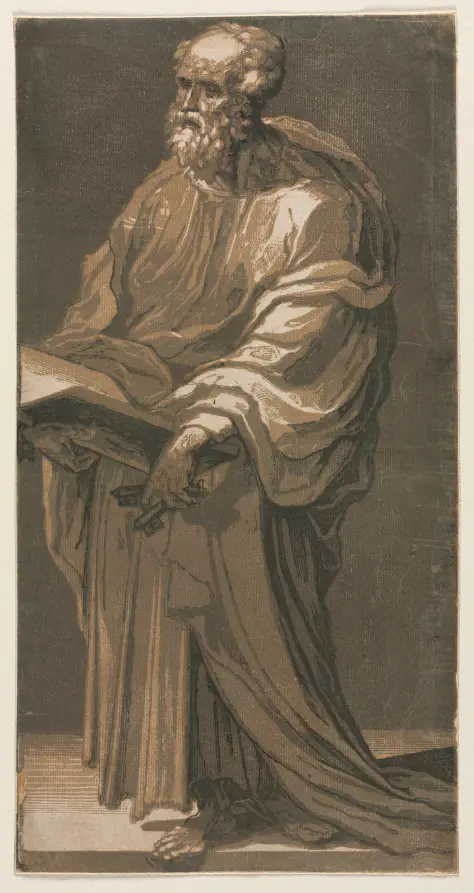
Cleveland Museum of Art162394portraitDomenico Beccafumi (Italian, 1486–1551)c. 1547CC0cma sacred-art portraits design-assets ink-paper-impressions objects-with-gravity sacred art design assets ink paper impressions objects with gravity elderly man old man scroll keys robes monochrome etching religious figure portrait brown tones 17th century classical serene detailed saint peterDomenico Beccafumi (Italian, 1486–1551) c. 1547 Italy, 16th century chiaroscuro woodcut printed in four shades of brown, [object Object] Print European PortraitSacred & Devotional Faces in Time The Maker’s Cabinet Ink, Paper & Impressions Objects with Gravity
Practical reuse
Use this artwork.
Verified CC0
This record carries an explicit open-use marker in the source metadata. Download the publication copy or follow the museum record for its master image.
Saint Peter by Domenico Beccafumi (Italian, 1486–1551) (c. 1547). Severance and Greta Millikin Purchase Fund Rights: CC0. https://clevelandart.org/art/2002.9
Vault de Lupin makes the source signal legible; it does not provide legal advice or replace the institution’s current rights statement.
From the museum record
Beccafumi was an important and extremely versatile Sienese artist––a painter of altarpieces, frescoes, and furniture, a sculptor in wood, stucco, and bronze, and a designer of a large portion of the inlaid marble floor in the Siena Cathedral. He was also one of the most imaginative, daring, and versatile printmakers of the Italian Renaissance. Although his first prints were engravings, in order to reproduce the rich, tonal effects of his drawings, Beccafumi began to make chiaroscuro woodcuts. Around 1547, he completed a series of six chiaroscuros of the apostles, including Saint Peter. These are the artist's most skillful, complex, and successful prints, and among the most extraordinary color prints in 16th-century Italy. The blocks were carved and printed in an innovative manner. In order to attain the brilliant highlights common in his chiaroscuro drawings, Beccafumi created the effect of thin white hatching lines on a dark ground. He also treated each impression as a separate work of art.
Lupin’s visual index
A monochrome etching depicts a bearded elderly man in a flowing robe, holding a scroll and keys.
Machine-assisted description · useful for discovery, not scholarship.
.webp)