Vol. I · The open image paperWinnipeg · Musée sans mursRecovered · Remembered · Returned
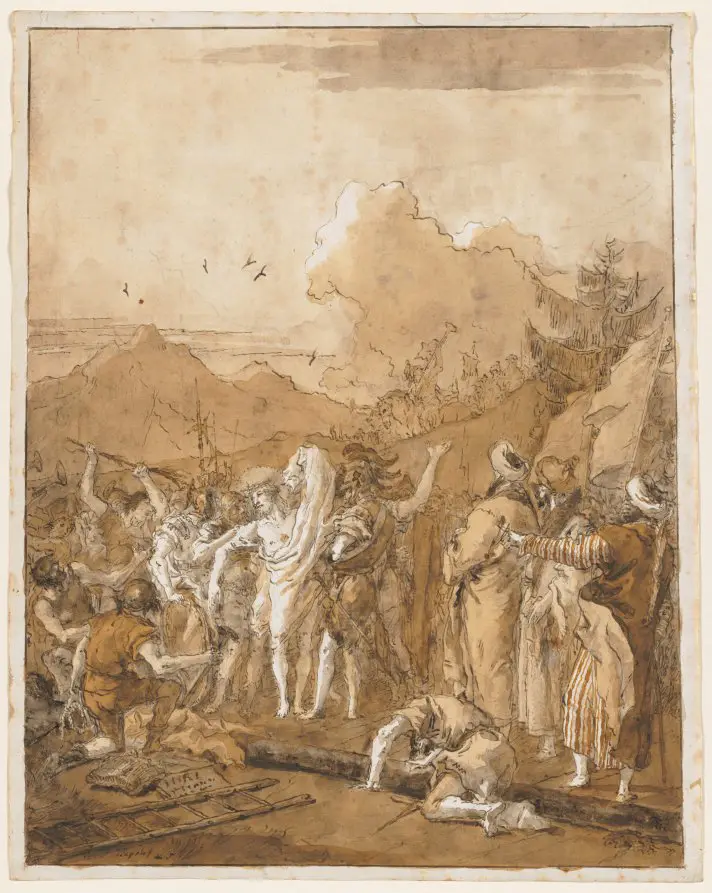
Cleveland Museum of Art161275portraitGiovanni Domenico Tiepolo (Italian, 1727–1804)c. 1785–90CC0cma african-global-heritage sacred-art portraits landscapes design-assets ink-paper-impressions african global heritage sacred art design assets ink paper impressions christ descent cross mourning drawing etching brown earth tones religious historical 17th century baroque sketch humanity suffering landscape figures composition the disrobingGiovanni Domenico Tiepolo (Italian, 1727–1804) c. 1785–90 Italy, Venice pen and brown and black ink, brush and black, brown, and red-brown wash, over black chalk; framing lines in pen and brown ink, [object Object] Drawing European ReligiousAfrican & Global Heritage Sacred & Devotional Faces in Time Horizons & Places The Maker’s Cabinet Ink, Paper & Impressions
Practical reuse
Use this artwork.
Verified CC0
This record carries an explicit open-use marker in the source metadata. Download the publication copy or follow the museum record for its master image.
The Disrobing of Christ by Giovanni Domenico Tiepolo (Italian, 1727–1804) (c. 1785–90). Purchase from the J. H. Wade Fund Rights: CC0. https://clevelandart.org/art/1999.5
Vault de Lupin makes the source signal legible; it does not provide legal advice or replace the institution’s current rights statement.
From the museum record
Giovanni Domenico Tiepolo, an important Venetian fresco painter of the 18th century, is best known today for his highly finished historical drawings that ingeniously incorporate details from daily life. This drawing, from a suite of more than 260 sheets known as the Large Biblical Series , depicts the Disrobing of Christ (the tenth Station of the Cross). A trio of patriarchs watch as Roman soldiers strip Jesus of his robe, a mob brews in the background, and over the lip of the hill, Roman soldiers trumpet the Crucifixion. The figure of Jesus, who glows with the stark white color of Domenico’s exposed paper, emerges simple and luminous from the chaos around him. His hammer-wielding executioner, emphasized with golden-brown wash, kneels before him—an ironic touch that implies the religious significance of Christ’s death. Domenico's signature technique, seen here, includes an underdrawing in black chalk or charcoal, contour lines drawn with a quill pen and brush, and modeling with a range of brown washes. His gestural, agitated lines evoke a strong sense of movement and emotional tension. The artist likely made the series for his own edification rather than for sale, as he kept the drawings during his lifetime and no prints were made.
Lupin’s visual index
A dramatic, brown-toned drawing depicts Christ's descent from the cross, surrounded by mourners and onlookers.
Machine-assisted description · useful for discovery, not scholarship.
.webp)