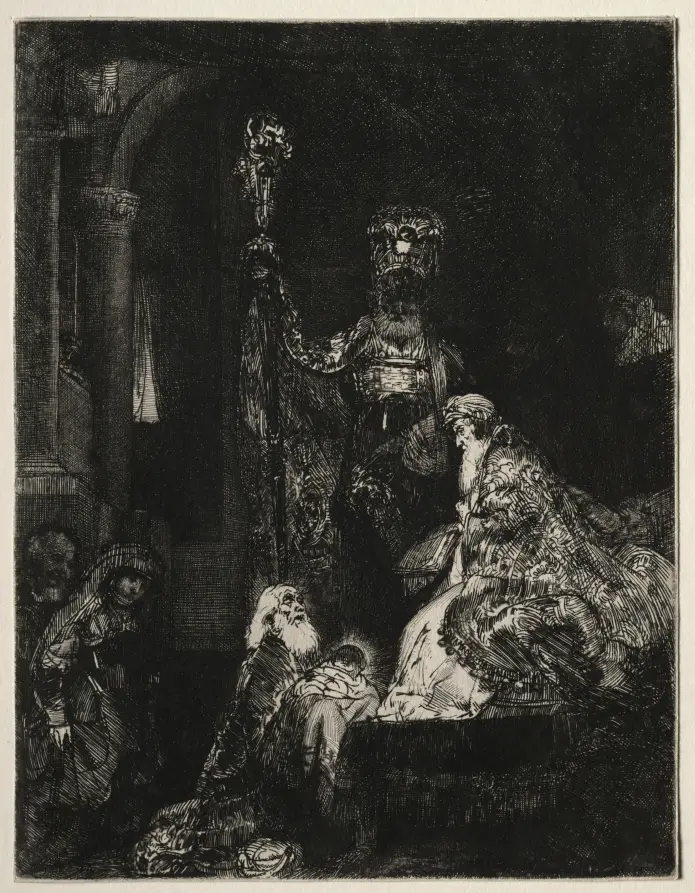
The Presentation in the Temple
Practical reuse

Use this artwork.

Verified CC0

This record carries an explicit open-use marker in the source metadata. Download the publication copy or follow the museum record for its master image.

Download publication WebP Open museum master ↗
Rights signal
CC0
Publication file
695 × 893 px · WebP
Suggested credit
The Presentation in the Temple by Rembrandt van Rijn (Dutch, 1606–1669) (c. 1654). Purchase from the J. H. Wade Fund Rights: CC0. https://clevelandart.org/art/1999.3

Vault de Lupin makes the source signal legible; it does not provide legal advice or replace the institution’s current rights statement.

From the museum record

Rembrandt often illustrated the intimate meaning of biblical events. Here Simeon, to whom "it was revealed ... by the Holy Ghost, that he should not see death before he had seen the Lord's Christ," holds up the infant Jesus toward the High Priest, a frail figure who allows the prayer book to slip from his grasp. At the left, the Virgin Mary and Joseph humbly kneel in the shadows, while a priest with an enormous crozier towers over all. To Rembrandt, light symbolized divinity and spirituality. By using an unsystematic network of fine crosshatching in the background and by varying the density of groups of parallel lines on the figures, he created an evocative atmosphere where forms emerge from shimmering half-lights. Rembrandt's ability to create a rich pictorial effect with linear means can only be fully appreciated in superb impressions such as this one, where the drypoint accents are fresh and strong and the nuances of the shading are perfectly realized.

Lupin’s visual index

a stark black and white engraving depicts a biblical scene of the magi visiting the infant jesus.

Machine-assisted description · useful for discovery, not scholarship.
Continue looking

Nearby in the vault.

The Presentation in the Temple

The Presentation in the Temple · Rembrandt van Rijn (Dutch, 1606–1669)

Your private shortlist

Saved works 0

Stored only in this browser. No account, tracking, or upload.

No works saved yet.

Use “Save work” on any catalogue card or artwork record to build a working collection.