Vol. I · The open image paperWinnipeg · Musée sans mursRecovered · Remembered · Returned
Cleveland Museum of Art150178portraitHans Baldung (German, 1484/85–1545)c. 1515–17CC0cma sacred-art symbols-patterns portraits design-assets ink-paper-impressions objects-with-gravity sacred art symbols patterns design assets ink paper impressions objects with gravity christian art engraving woodcut religious heaven ascension angels mourning baroque monochrome grayscale classical detail composition symbolism renaissance etching divine christ carriedHans Baldung (German, 1484/85–1545) c. 1515–17 Germany woodcut Print European ReligiousSacred & Devotional Symbols & Ornament Faces in Time The Maker’s Cabinet Ink, Paper & Impressions Objects with Gravity
Practical reuse
Use this artwork.
Verified CC0
This record carries an explicit CC0 marker in the source metadata. Download the publication copy or follow the source record for its master image.
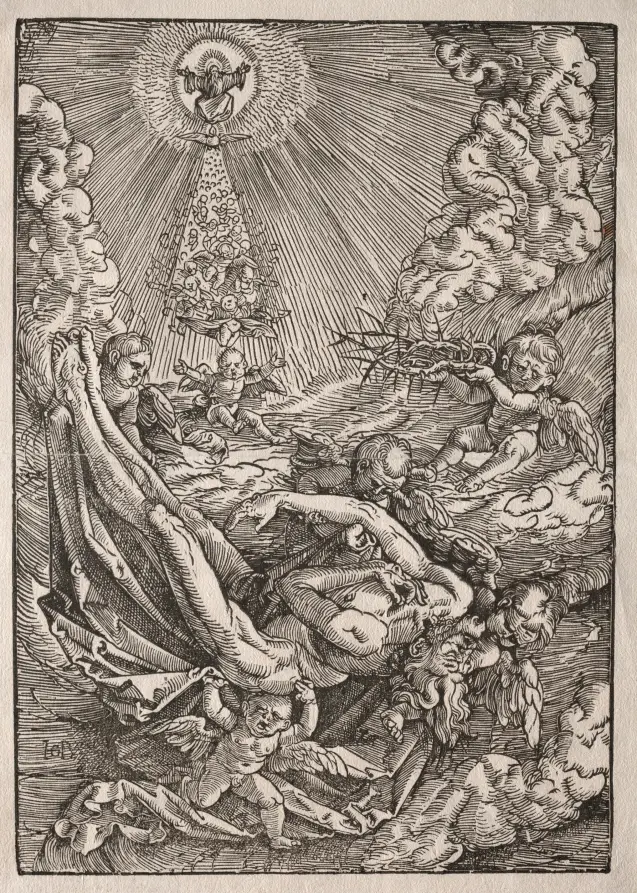
Christ Carried to Heaven by Angels by Hans Baldung (German, 1484/85–1545) (c. 1515–17). Dudley P. Allen Fund Rights: CC0. https://clevelandart.org/art/1980.93
Vault de Lupin makes the source signal legible; it does not provide legal advice or replace the institution’s current rights statement.
From the museum record
Baldung, who lived in Strasbourg, was Albrecht Dürer's most talented pupil. A highly original artist, he produced about 550 woodcuts. The origin of his nickname, Grien, to which the G in his monogram refers, is unclear. It may allude to his predilection for the color green, or it may derive from Grienhans, meaning devil (demonic fantasies appear in some of the artist's works). Baldung often avoided conventional compositions in favor of an innovative depiction of greater pathos and drama. Although a living Christ had long been shown ascending to heaven, Baldung's representation—in which Christ's corpse is carried heavenward by angels—is unprecedented. In contrast to the celestial splendor at the top of this composition, where God the Father and the dove of the Holy Spirit are illuminated by a burst of radiant light, Christ is shown in a harshly awkward position, accentuating his torment and suffering. The angels labor to carry the heavy body, which appears to be sinking downward, reminiscent of scenes of the entombment, in which Christ is lowered into a grave. This devotional image gives visual form to one of the central mysteries of the Christian faith, the contradiction between Christ's human suffering and his divine nature, symbolized by the grandeur of heaven.
Lupin’s visual index
a monochromatic engraving depicts christ's ascent into heaven surrounded by angels and grieving figures.
Machine-assisted description · useful for discovery, not scholarship.