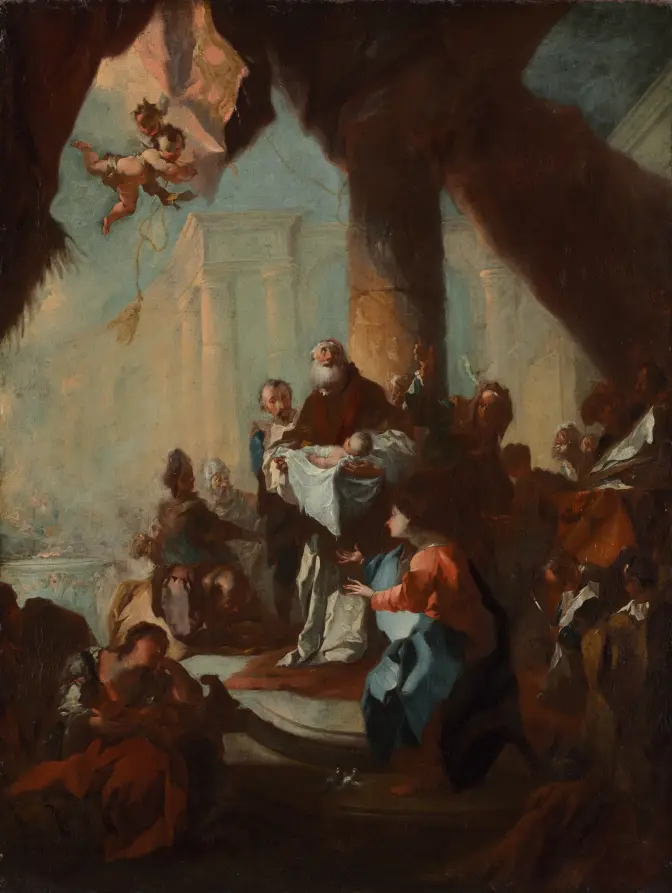
Study for "The Presentation of Christ in the Temple" (for Saint Ulrich, Vienna)
Practical reuse

Use this artwork.

Verified CC0

This record carries an explicit open-use marker in the source metadata. Download the publication copy or follow the museum record for its master image.

Download publication WebP Open museum master ↗
Rights signal
CC0
Publication file
672 × 893 px · WebP
Suggested credit
Study for "The Presentation of Christ in the Temple" (for Saint Ulrich, Vienna) by Franz Anton Maulbertsch (Austrian, 1724–1796) (c. 1750). Mr. and Mrs. William H. Marlatt Fund Rights: CC0. https://clevelandart.org/art/1963.326

Vault de Lupin makes the source signal legible; it does not provide legal advice or replace the institution’s current rights statement.

From the museum record

This loosely painted sketch is the preliminary design for an altarpiece in the Church of Saint Ulrich, Vienna. Mary and Joseph have brought the infant Jesus to the temple to be inducted into the Jewish faith; the aged priest Simeon cradles the infant in his arms, turning his gaze to heaven as he realizes that he is holding the Son of God. Strong contrasts of light and shadow underscore the drama of the moment. The frame is not original to this painting, but was made by an Austrian craftsman in the mid-1700s. Its florid style suits Maulbertsch’s flickering brushwork, and reflects the tradition of wood sculpture from Central Europe seen in other objects in the CMA's collection.

Lupin’s visual index

A baroque painting depicts Saint George presenting holy oil to the infant Jesus surrounded by onlookers.

Machine-assisted description · useful for discovery, not scholarship.
Continue looking

Nearby in the vault.

Study for "The Presentation of Christ in the Temple" (for Saint Ulrich, Vienna)

Study for "The Presentation of Christ in the Temple" (for Saint Ulrich, Vienna) · Franz Anton Maulbertsch (Austrian, 1724–1796)

Your private shortlist

Saved works 0

Stored only in this browser. No account, tracking, or upload.

No works saved yet.

Use “Save work” on any catalogue card or artwork record to build a working collection.