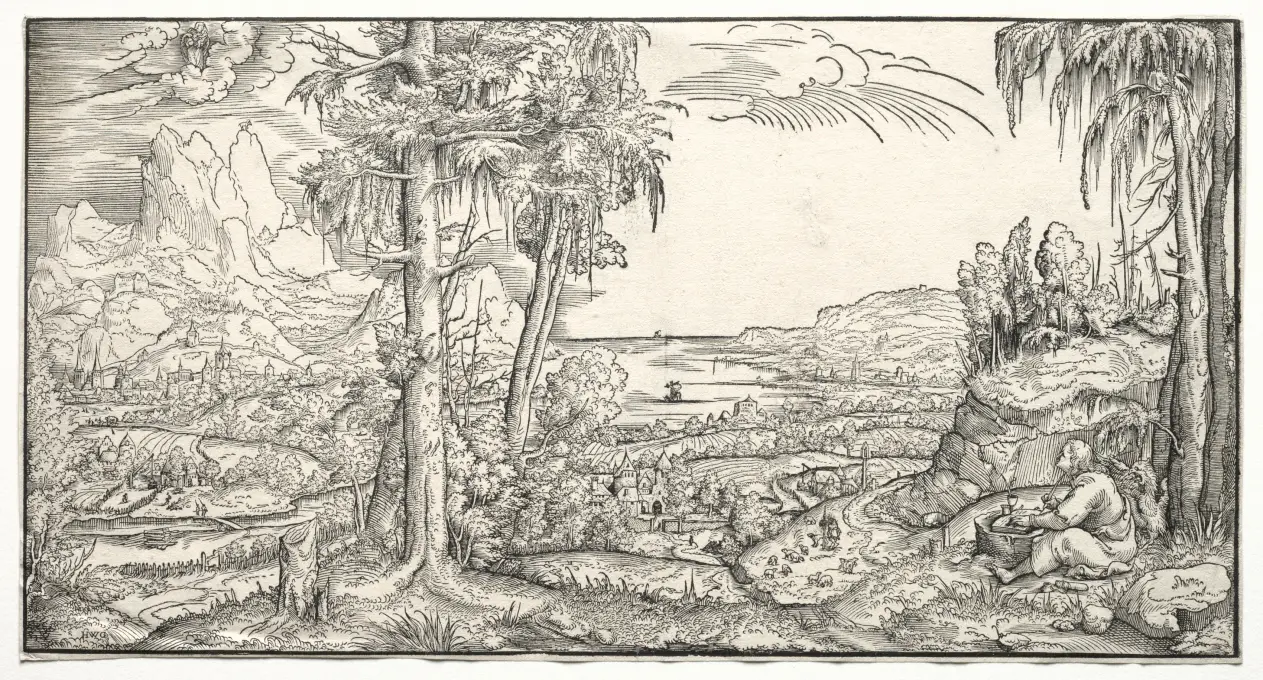
St. John on the Island of Patmos
Practical reuse

Use this artwork.

Verified CC0

This record carries an explicit open-use marker in the source metadata. Download the publication copy or follow the museum record for its master image.

Download publication WebP Open museum master ↗
Rights signal
CC0
Publication file
1263 × 680 px · WebP
Suggested credit
St. John on the Island of Patmos by Virgil Solis (German, 1514–1562) (c. 1545–55). John L. Severance Fund Rights: CC0. https://clevelandart.org/art/1954.565

Vault de Lupin makes the source signal legible; it does not provide legal advice or replace the institution’s current rights statement.

From the museum record

Christian tradition says that after Christ’s death, John the Evangelist was exiled to the Aegean island Patmos, where he composed the Book of Revelation based on a series of prophetic visions. Here, Saint John gazes upward toward a vision of the woman of the apocalypse (traditionally interpreted as the Virgin Mary) in the top left corner. The artist’s composition implies that John’s vision was partially inspired by his isolation within nature—portrayed in a wide expanse featuring dramatic peaks and fir trees, castles, farms, shepherds, and even a merchant’s ship on a vast harbor.

Lupin’s visual index

This engraving depicts a detailed, atmospheric alpine scene with a small village and figures amidst a rugged mountainous terrain.

Machine-assisted description · useful for discovery, not scholarship.
Continue looking

Nearby in the vault.

St. John on the Island of Patmos

St. John on the Island of Patmos · Virgil Solis (German, 1514–1562)

Your private shortlist

Saved works 0

Stored only in this browser. No account, tracking, or upload.

No works saved yet.

Use “Save work” on any catalogue card or artwork record to build a working collection.