Vol. I · The open image paperWinnipeg · Musée sans mursRecovered · Remembered · Returned
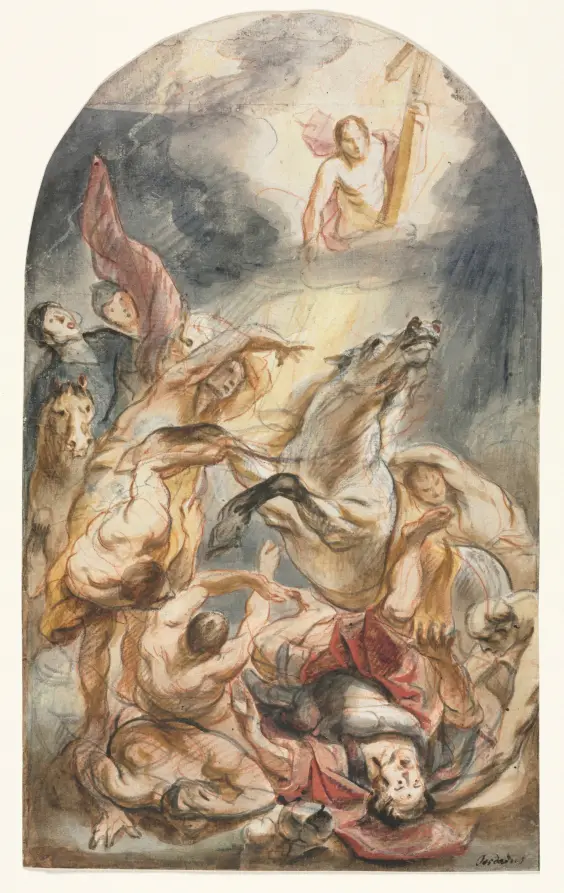
Cleveland Museum of Art131791portraitJacob Jordaens (Flemish, 1593–1678)c. 1645–47CC0cma african-global-heritage sacred-art design-assets ink-paper-impressions african global heritage sacred art design assets ink paper impressions christ ascension angels religious painting sketch renaissance baroque light red brown figures sky heaven drawing classical composition the conversion saul and crossJacob Jordaens (Flemish, 1593–1678) c. 1645–47 Flanders brush and brown wash, gouache and watercolor over black and red chalk, heightened with traces of white; framing lines in graphite, [object Object] Drawing European ReligiousAfrican & Global Heritage Sacred & Devotional The Maker’s Cabinet Ink, Paper & Impressions
Practical reuse
Use this artwork.
Verified CC0
This record carries an explicit open-use marker in the source metadata. Download the publication copy or follow the museum record for its master image.
The Conversion of Saul with Christ and the Cross by Jacob Jordaens (Flemish, 1593–1678) (c. 1645–47). Delia E. Holden and L. E. Holden Funds Rights: CC0. https://clevelandart.org/art/1954.367
Vault de Lupin makes the source signal legible; it does not provide legal advice or replace the institution’s current rights statement.
From the museum record
Jacob Jordaens was a prominent artist working in Antwerp in the 17th century. Though influenced in his use of powerful forms and vibrant color by his contemporary, Peter Paul Rubens, Jordaens was notably more realist in his tendencies. This drawing and its companion drawing in the Cleveland Museum of Art's collection (1954.366) are very likely studies for a painting depicting the Conversion of Saint Paul that Jordaens made for the the abbey church at Tongerlo, near Antwerp, in around 1647 (now lost). According to the Bible, in the year following the death of Jesus Christ, Saul of Tarsus (who became Saint Paul) was on the road to Damascus. He was suddenly surrounded by a brilliant light from above, heard the voice of Christ, and became a believer. In this work, Saul appears to have been blinded by the force of Christ's voice and heavenly light. Jordaens used a combination of chalks and wet media such as ink and watercolor to create a swirling mass of bodies bathed in light.
Lupin’s visual index
A dramatic depiction of Christ's ascension into heaven, surrounded by angels and onlookers.
Machine-assisted description · useful for discovery, not scholarship.
.webp)