Vol. I · The open image paperWinnipeg · Musée sans mursRecovered · Remembered · Returned
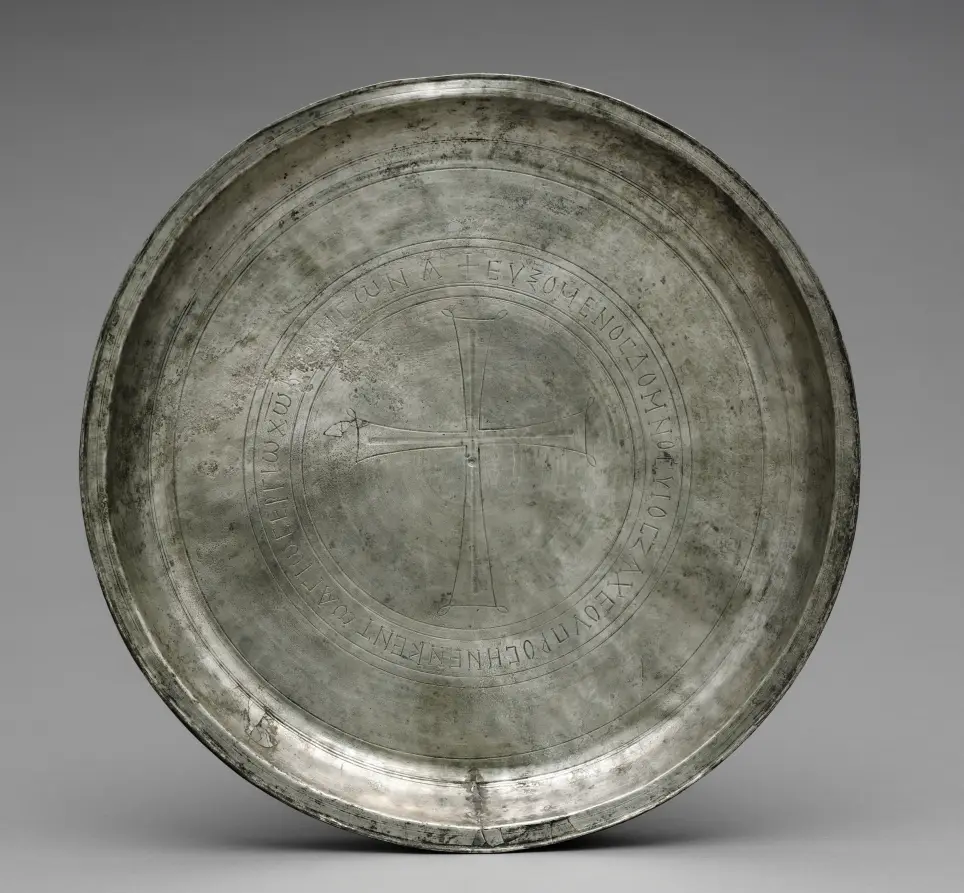
Cleveland Museum of Art127719squarec. 500CC0cma african-global-heritage sacred-art symbols-patterns flora-fauna design-assets african global heritage sacred art symbols patterns flora fauna design assets silver plate cross religious greek medieval inscribed metalware patina antique religious art byzantine silver circular inscription symbol historical artifact grey dark grey paten dedicated saint sergius the beth misona treasurec. 500 early Byzantium, Constantinople or Syria, Byzantine period, 6th-7th Century silver Metalwork ReligiousAfrican & Global Heritage Sacred & Devotional Symbols & Ornament The Living World The Maker’s Cabinet
Practical reuse
Use this artwork.
Verified CC0
This record carries an explicit CC0 marker in the source metadata. Download the publication copy or follow the source record for its master image.
Paten (Dedicated to Saint Sergius) from the Beth Misona Treasure (c. 500). Purchase from the J. H. Wade Fund Rights: CC0. https://clevelandart.org/art/1950.381
Vault de Lupin makes the source signal legible; it does not provide legal advice or replace the institution’s current rights statement.
From the museum record
These four liturgical silver vessels—a paten and three chalices (1950.378–81)—form what is now called the Beth Misona Treasure, named for the village in northern Syria for which the objects were made. While nothing is known about the exact location and circumstances of the treasure's discovery, the people of the village of Beth Misona were, like other Christian communities in Syria and Palestine, probably forced to bury their church silver to hide it from the Persians or Arabs, who conquered their lands in the first half of the 600s. The paten, which held pieces of Eucharistic bread used during Mass, is decorated with an engraved Latin cross surrounded by a dedicatory inscription that names the paten's donor—Domnos—and its original location, the church of Saint Sergios in Beth Misona. The chalices, which contained the Eucharistic wine used during Mass, feature broad cups decorated with portrait busts of Saints Peter and Paul, Christ, and the Virgin. One chalice bears a dedicatory inscription naming its donor—Kyriakos, Domnos's son—and the priest of the church that received the pious gift—Zeno.
Lupin’s visual index
A weathered silver plate features a central cross surrounded by Greek inscriptions.
Machine-assisted description · useful for discovery, not scholarship.