Vol. I · The open image paperWinnipeg · Musée sans mursRecovered · Remembered · Returned
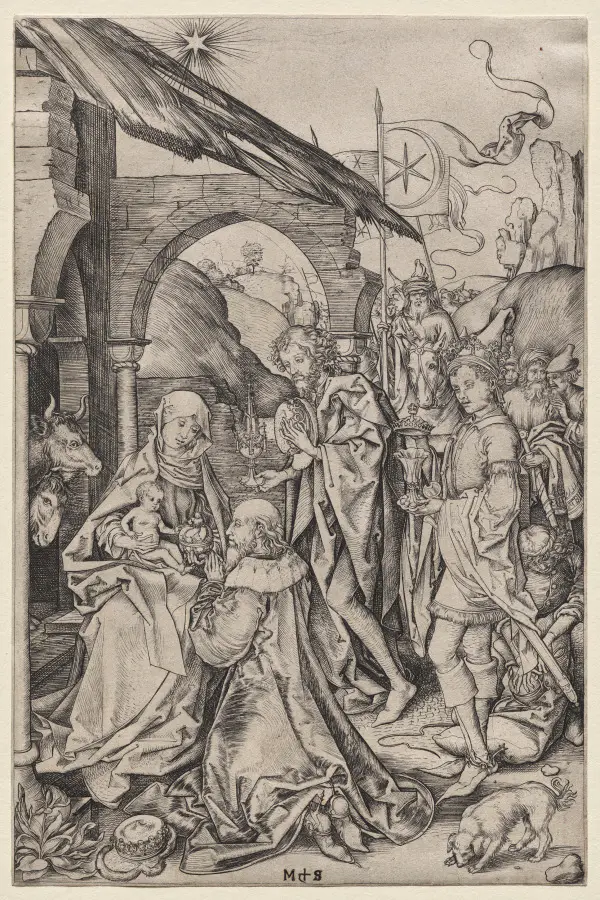
Cleveland Museum of Art121194portraitMartin Schongauer (German, c. 1450–1491)1482CC0cma sacred-art portraits design-assets ink-paper-impressions sacred art design assets ink paper impressions engraving printmaking religious christian nativity magi advent albrecht dürer renaissance german etching dark monochrome detail stable gift child scene 15th century adoration theMartin Schongauer (German, c. 1450–1491) 1482 Germany engraving Print European ReligiousSacred & Devotional Faces in Time The Maker’s Cabinet Ink, Paper & Impressions
Practical reuse
Use this artwork.
Verified CC0
This record carries an explicit CC0 marker in the source metadata. Download the publication copy or follow the source record for its master image.
Adoration of the Magi by Martin Schongauer (German, c. 1450–1491) (1482). Dudley P. Allen Fund Rights: CC0. https://clevelandart.org/art/1942.1070
Vault de Lupin makes the source signal legible; it does not provide legal advice or replace the institution’s current rights statement.
From the museum record
The print belongs to a set of four engravings considered to be an incomplete series of episodes of the Life of the Virgin, which also includes the Nativity (1939.448), The Flight into Egypt (1954.260), and The Death of the Virgin (1956.744). Here, Martin Schongauer portrayed the visit of the three magi and their long retinue as witnesses to the miraculous birth of Jesus Christ as recounted in the biblical book of Matthew. The Virgin Mary is seated in front of the entrance of a stable made up from the ruins of a building. She holds the Christ child on her lap and hands him a box containing gold, the gift from the oldest of the three Kings, Melchior, who is kneeling in front of them. Behind Melchior are the other two Kings, Caspar and Balthazar, who offer a censer in the shape of a Gothic monstrance and a goblet of myrrh, respectively. At the top of the roof of the stable, the star of Bethlehem blazes.
Lupin’s visual index
This detailed engraving depicts the biblical scene of the Magi presenting gifts to the infant Jesus, set within a rustic stable.
Machine-assisted description · useful for discovery, not scholarship.