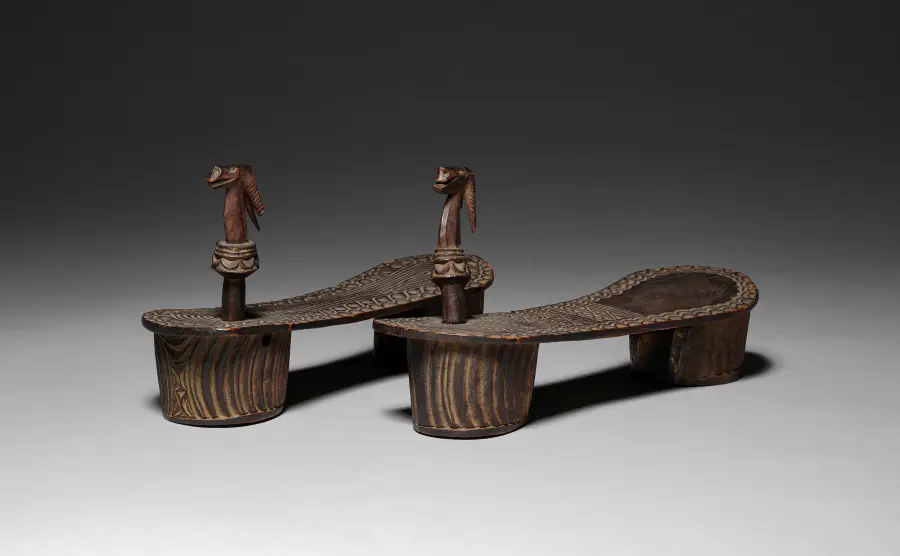
Sandals (mitalawanda / mitawanda) or Clogs (kiatu cha mti)
Practical reuse

Use this artwork.

Verified CC0

This record carries an explicit open-use marker in the source metadata. Download the publication copy or follow the museum record for its master image.

Download publication WebP Open museum master ↗
Rights signal
CC0
Publication file
900 × 556 px · WebP
Suggested credit
Sandals (mitalawanda / mitawanda) or Clogs (kiatu cha mti) (c. 1800s). Educational Purchase Fund Rights: CC0. https://clevelandart.org/art/1929.566

Vault de Lupin makes the source signal legible; it does not provide legal advice or replace the institution’s current rights statement.

From the museum record

Common in the Indian Ocean region, wooden sandals changed meaning across place and time. This pair’s base elevates the foot as the toes grip an antelope-shaped peg ( msuruaki ). Crisp geometric sole designs suggest they were rarely worn. East African elites and merchants once had exclusive rights to wooden shoes, wearing elaborate ones only for portraits. Formerly enslaved people living along the coast wore simpler ones from the 1840s onward, adopting elite footwear to assert their liberation. However, slave traders like the Zanzibari “Tippu Tip” (c. 1832–1905) likely brought mitalawanda to Central Africa; stylistic elements of this pair hail from that region.

Lupin’s visual index

A pair of dark wood seats with intricate geometric carvings and bird motifs are presented on a neutral background.

Machine-assisted description · useful for discovery, not scholarship.
Continue looking

Nearby in the vault.

Sandals (mitalawanda / mitawanda) or Clogs (kiatu cha mti)

Sandals (mitalawanda / mitawanda) or Clogs (kiatu cha mti)

Your private shortlist

Saved works 0

Stored only in this browser. No account, tracking, or upload.

No works saved yet.

Use “Save work” on any catalogue card or artwork record to build a working collection.