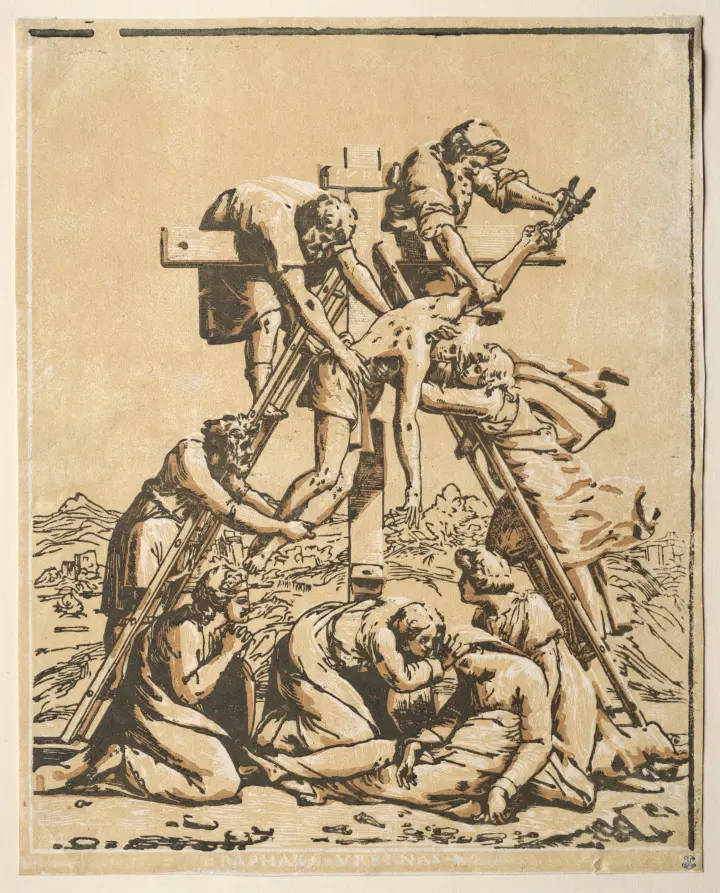
Descent from the Cross
Practical reuse

Use this artwork.

Verified CC0

This record carries an explicit open-use marker in the source metadata. Download the publication copy or follow the museum record for its master image.

Download publication WebP Open museum master ↗
Rights signal
CC0
Publication file
720 × 893 px · WebP
Suggested credit
Descent from the Cross by Ugo da Carpi (Italian, c. 1479–c. 1532) (c. 1518). Gift of the President and Directors of the Baltimore and Ohio Railroad Rights: CC0. https://clevelandart.org/art/1925.984

Vault de Lupin makes the source signal legible; it does not provide legal advice or replace the institution’s current rights statement.

From the museum record

Ugo da Carpi was influential in the development of the chiaroscuro woodcut in Italy. The term chiaroscuro combines the Italian words chiaro (light) and scuro (dark). Invented to emulate drawings with light and dark pigments on tinted paper, the printing technique uses multiple woodblocks to layer different tones of color. The Descent from the Cross is one of the earliest chiaroscuro woodcuts by Ugo da Carpi. This print credits Raphael with its design: it was inspired by one of Raphael's now-lost drawings for a scene of Deposition that he should have painted in Loggie Vaticane. In a sketch-like hilly landscape, Christ's dead body is taken down from the cross by four men, one of whom is removing the nail from his right palm. Below, the three Marys attend the fainted Virgin. For this woodcut, Ugo used three different blocks—light brown, dark brown, and black.

Lupin’s visual index

A group of men meticulously dissect a deceased body in a dimly lit workshop.

Machine-assisted description · useful for discovery, not scholarship.
Continue looking

Nearby in the vault.

Descent from the Cross

Descent from the Cross · Ugo da Carpi (Italian, c. 1479–c. 1532)

Your private shortlist

Saved works 0

Stored only in this browser. No account, tracking, or upload.

No works saved yet.

Use “Save work” on any catalogue card or artwork record to build a working collection.