Vol. I · The open image paperWinnipeg · Musée sans mursRecovered · Remembered · Returned
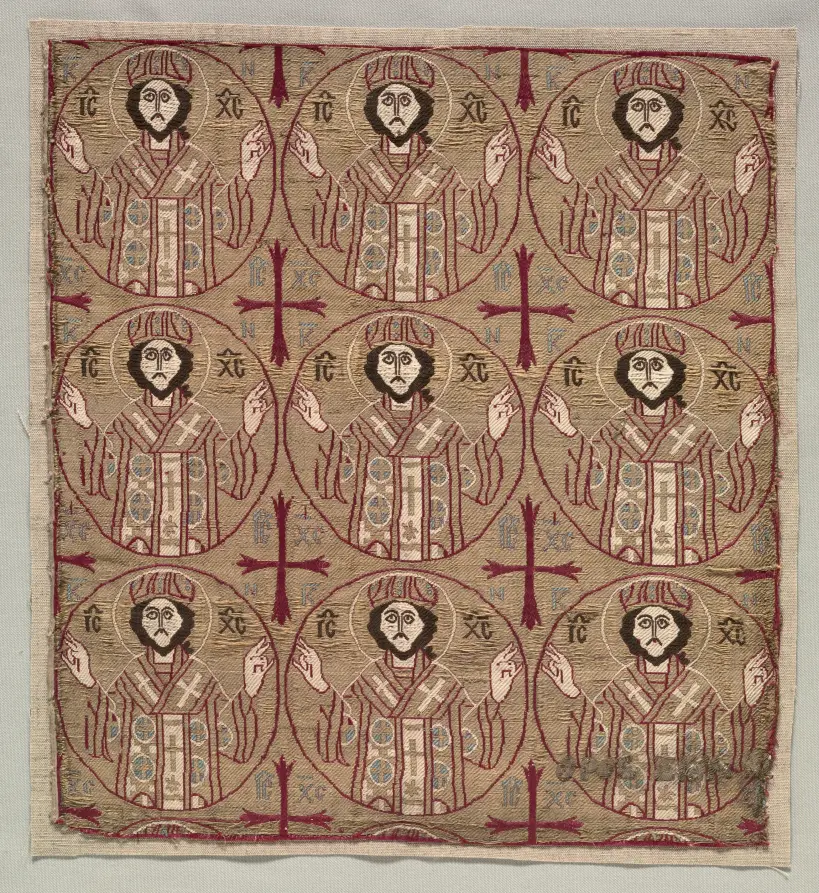
Cleveland Museum of Art95721square1550–1650CC0cma african-global-heritage sacred-art symbols-patterns portraits design-assets african global heritage sacred art symbols patterns design assets tapestry medieval religious christian apostles halo cross geometric woven wool fabric illumination byzantine 12th century fragment pattern lampas roundels the image christ benedictory pose1550–1650 Turkey, Bursa, Ottoman period Silk and gilt-metal thread: lampas Textile ReligiousAfrican & Global Heritage Sacred & Devotional Symbols & Ornament Faces in Time The Maker’s Cabinet
Practical reuse
Use this artwork.
Verified CC0
This record carries an explicit open-use marker in the source metadata. Download the publication copy or follow the museum record for its master image.
Lampas with roundels of the image of Christ in benedictory pose (1550–1650). Gift of Mr. and Mrs. J. H. Wade Rights: CC0. https://clevelandart.org/art/1916.1423
Vault de Lupin makes the source signal legible; it does not provide legal advice or replace the institution’s current rights statement.
From the museum record
Ottoman manufacturers also wove luxury silks with Christian images for the largest markets outside of the reigning sultans, whose need for luxury fabrics was voracious, targeting the Balkans, Eastern Europe, and the state of Muscovy (Moscow), which lacked silk industries. Worn as majestic church vestments, they were prized signifiers of the power and wealth of the Eastern Orthodox church. Christian imagery is often displayed in small medallion patterns, as seen here, woven in the standard Ottoman lampas technique. In this highest grade lampas with extensive gilt-metal thread, small medallions enclose half-length images of Christ in a benedictory pose alternating with crosses. The abbreviated inscription in the roundel, IC XC, translates as "Jesus Christ."
Lupin’s visual index
This medieval tapestry fragment depicts twelve haloed apostles arranged in a symmetrical grid, surrounded by crosses and geometric patterns.
Machine-assisted description · useful for discovery, not scholarship.
.webp)