Vol. I · The open image paperWinnipeg · Musée sans mursRecovered · Remembered · Returned
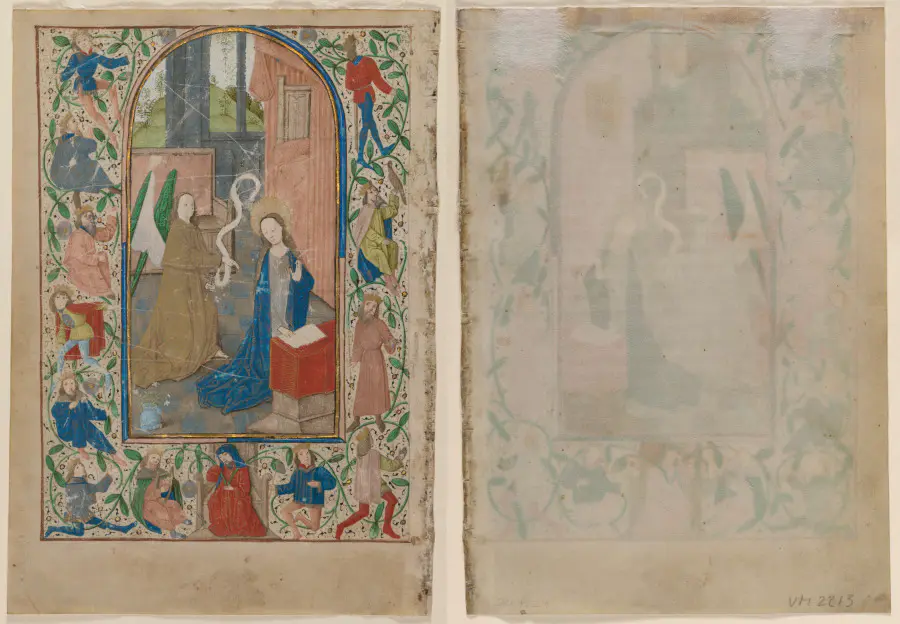
Cleveland Museum of Art171436landscape1470sCC0cma symbols-patterns portraits ink-paper-impressions symbols patterns ink paper impressions medieval manuscript illumination religious bible figures border ornate red gold brown medieval art gothic stained glass fresco historical art leaf book hours the annunciation1470s Flanders, Ghent(?) ink, tempera, and gold on vellum Manuscript ReligiousSymbols & Ornament Faces in Time Ink, Paper & Impressions
Practical reuse
Use this artwork.
Verified CC0
This record carries an explicit open-use marker in the source metadata. Download the publication copy or follow the museum record for its master image.
Leaf from a Book of Hours: The Annunciation (1470s). The Jeanne Miles Blackburn Collection Rights: CC0. https://clevelandart.org/art/2014.24
Vault de Lupin makes the source signal legible; it does not provide legal advice or replace the institution’s current rights statement.
From the museum record
The Annunciation is the traditional introduction to matins, the first of the eight canonical hours. This striking scene recalls the archangel Gabriel's announcement to the Virgin Mary that she was to become the mother of God. The humble scene, steeped in monumentality and innocence, honors one of the most significant moments in Christian history—the coming of God into the world. Flemish artists, in particular, tenderly elaborated this event. The Virgin is usually shown within an architectural interior. Typically her bedroom, this interior space includes a curtained bed, a wooden bench, windows through which a landscape is revealed, and a simple earthenware ewer filled with lilies that proclaim her innocence. Within this private setting, Mary kneels to read from an open book of hours. Her prayer is interrupted by the angel's appearance and she is captured by the artist in stunned surprise. The miniature is accompanied by an illustration in the margins of the Tree of Jesse, the family tree showing Jesus's human descent from Jesse, the father of King David, through the royal house of Judah. The motif begins in the lower margin with the seated Jesse, from whom a tree grows. David, Solomon, and various kings and prophets can be seen in its branches.
Lupin’s visual index
two pages of a medieval illuminated manuscript depict a scene of biblical figures within ornate, decorative borders.
Machine-assisted description · useful for discovery, not scholarship.
.webp)