Club (Knobkerrie)
Practical reuse

Use this artwork.

Verified CC0

This record carries an explicit open-use marker in the source metadata. Download the publication copy or follow the museum record for its master image.

Download publication WebP Open museum master ↗
Rights signal
CC0
Publication file
557 × 893 px · WebP
Suggested credit
Club (Knobkerrie) (1800s–1900s). Leonard C. Hanna Jr. Fund Rights: CC0. https://clevelandart.org/art/2010.203

Vault de Lupin makes the source signal legible; it does not provide legal advice or replace the institution’s current rights statement.

From the museum record

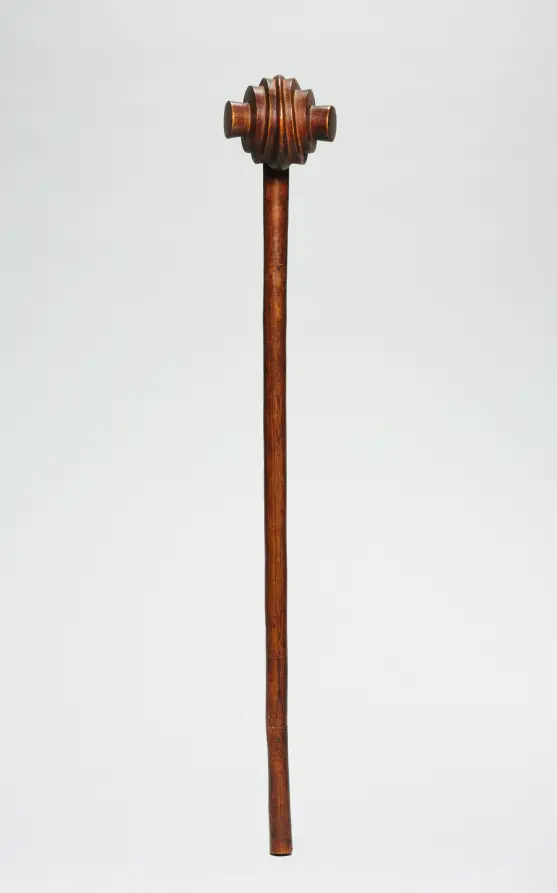
Relatively short sticks historically used for hunting and fighting are customarily called knobkerries. A combination of Afrikaans and Shona words, the name refers to the characteristic spherical knob of wood (knop) or head atop a cylindrical shaft ( kirri ). The knobs on these were carved into a tight whorl and a compressed sphere with a central rib. Even though their basic shapes were derived from real weapons, many of these precious objects were rarely if ever used as such. Highly personal, they instead functioned as ceremonial display items or regalia, symbolizing the masculinity and prowess of their owner.

Lupin’s visual index

A richly-toned wooden walking stick with a decorative, rounded head rests vertically against a gray background.

Machine-assisted description · useful for discovery, not scholarship.
Continue looking

Nearby in the vault.

Club (Knobkerrie)

Club (Knobkerrie)

Your private shortlist

Saved works 0

Stored only in this browser. No account, tracking, or upload.

No works saved yet.

Use “Save work” on any catalogue card or artwork record to build a working collection.