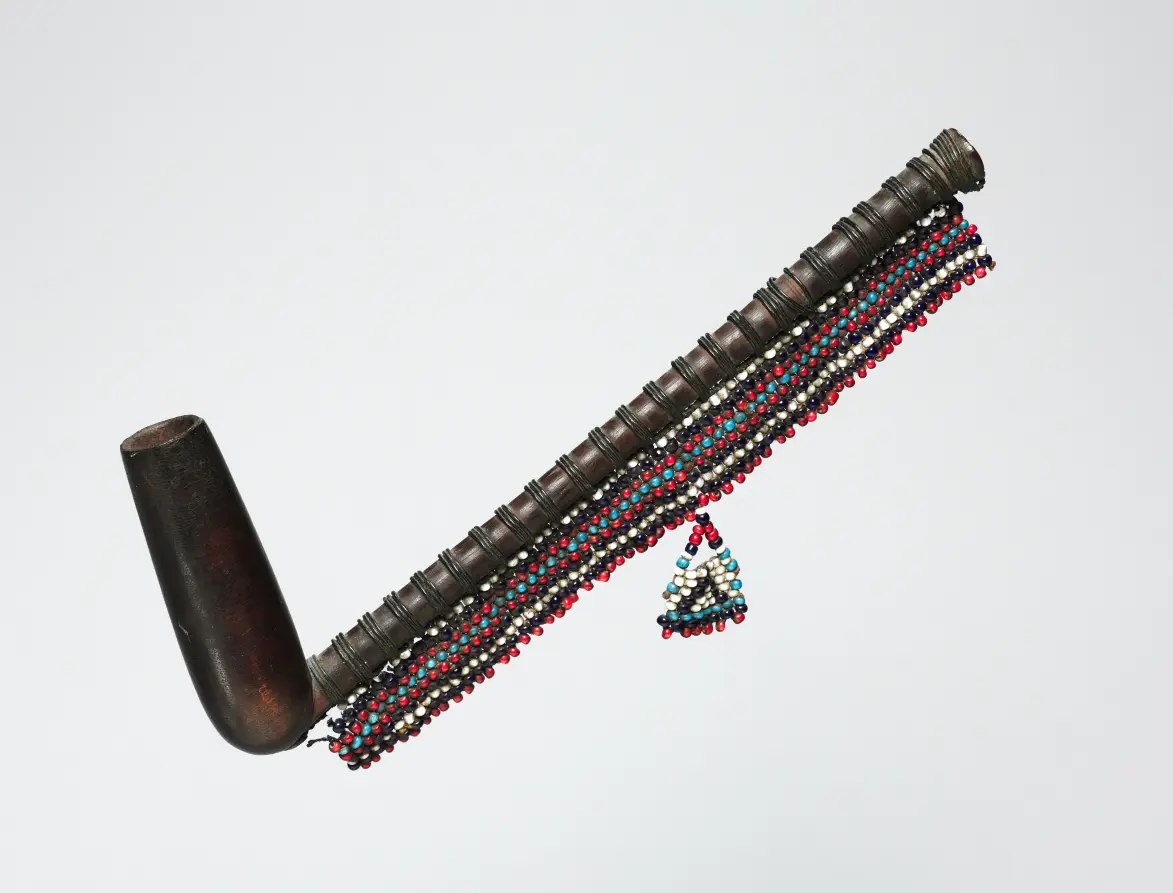
Pipe
Practical reuse

Use this artwork.

Verified CC0

This record carries an explicit open-use marker in the source metadata. Download the publication copy or follow the museum record for its master image.

Download publication WebP Open museum master ↗
Rights signal
CC0
Publication file
1173 × 893 px · WebP
Suggested credit
Pipe (1800s–1900s). Leonard C. Hanna Jr. Fund Rights: CC0. https://clevelandart.org/art/2010.199

Vault de Lupin makes the source signal legible; it does not provide legal advice or replace the institution’s current rights statement.

From the museum record

Mothers often used long-stemmed pipes like this because they helped direct smoke away from the babies they carried on their backs. Carved by men, pipes were used by both men and women. A female maker added beaded fringe using a color scheme typical of Xhosa beadwork. The miniature apron suspended from the fringe suggests a woman’s garment, and thus ownership of this pipe. Social and leisure practices, smoking and snuffing tobacco were also associated with the ancestors and with ideas of fertility and procreation. Inherited between individuals and families, pipes have connected clans and generations and thus linked the worldly present with the ancestral past.

Lupin’s visual index

A richly decorated Kazakh silk instrument rests on a neutral background, showcasing intricate beadwork and wood.

Machine-assisted description · useful for discovery, not scholarship.
Continue looking

Nearby in the vault.

Pipe

Pipe

Your private shortlist

Saved works 0

Stored only in this browser. No account, tracking, or upload.

No works saved yet.

Use “Save work” on any catalogue card or artwork record to build a working collection.