Vol. I · The open image paperWinnipeg · Musée sans mursRecovered · Remembered · Returned
Cleveland Museum of Art138883portraitModerno (Italian, 1467–1528)c. 1500CC0cma sacred-art ink-paper-impressions objects-with-gravity sacred art ink paper impressions objects with gravity relief sculpture nativity christ child mary joseph stable gold religious art medieval italian renaissance byzantine gold leaf detailed religious christmas scene etching pax the adoration magiModerno (Italian, 1467–1528) c. 1500 Italy, 16th century gilt bronze Sculpture European ReligiousSacred & Devotional Ink, Paper & Impressions Objects with Gravity
Practical reuse
Use this artwork.
Verified CC0
This record carries an explicit CC0 marker in the source metadata. Download the publication copy or follow the source record for its master image.
Pax with the Adoration of the Magi by Moderno (Italian, 1467–1528) (c. 1500). Charles W. Harkness Endowment Fund and Various Donors by exchange Rights: CC0. https://clevelandart.org/art/1963.254
Vault de Lupin makes the source signal legible; it does not provide legal advice or replace the institution’s current rights statement.
From the museum record
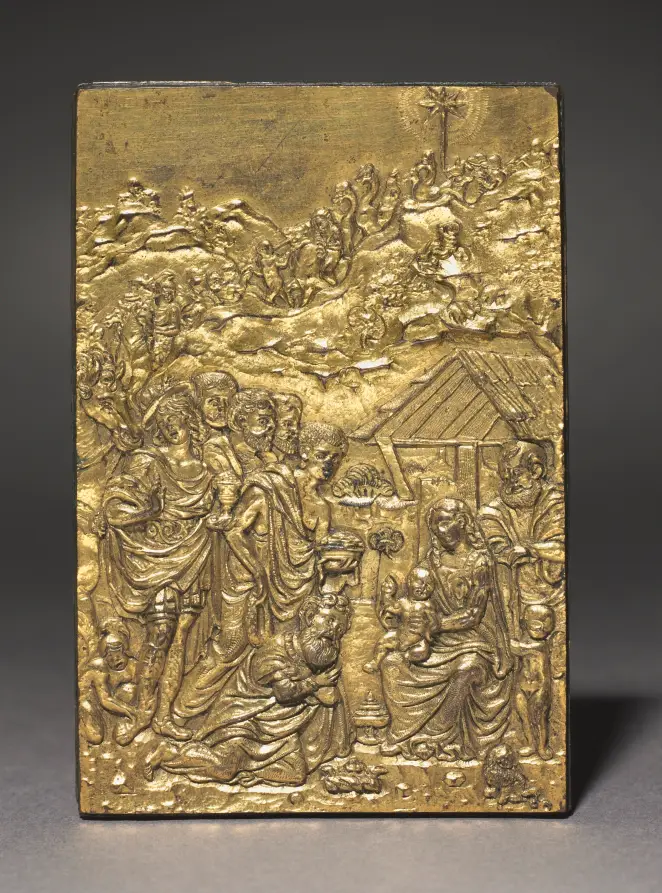
A pax is a small flat tablet decorated with Christian images and meant to be kissed by the priest before Communion. This plaquette likely had a tabernacle-shaped frame which has been cut away. Here the Madonna sits before a stable with a nude Christ Child seated on her right knee. A star with a long vertical ray radiates in the distance above the stable. Joseph stands on the right edge of the relief, while a nude child, likely a young John the Baptist, appears beside Joseph. The Three Kings approach the Holy Family with gifts, the first kneeling, his arms folded across his chest, while a kneeling male, nude except for a helmet, adjusts the sandal of the third king. A long procession follows the magi, continuing diagonally up the rocky hills in the background. This rocky landscape and crowded figures animate the surface, conveying the excitement and haste as visitors journey to see the newborn king. An inscription on the back of the plaquette reads "This has been given as a gift to Andrea Aiardo, Archbishop of Brundisi by Ioannes Baptista Fontanus, Goldsmith, in the year of our Lord 1583." Other versions of this plaquette exist in the British Museum, the Victoria and Albert Museum, the Louvre, the Berlin State Museums, and the Metropolitan Museum of Art. --Ana Dieglio (2009)
Lupin’s visual index
a highly detailed, gilded relief depicts the birth of christ in a rustic stable setting.
Machine-assisted description · useful for discovery, not scholarship.