Vol. I · The open image paperWinnipeg · Musée sans mursRecovered · Remembered · Returned
Cleveland Museum of Art110126portrait1300–1320CC0cma sacred-art portraits landscapes flora-fauna objects-with-gravity sacred art flora fauna objects with gravity medieval sculpture christ mourning silver gilt religious art catholic figure seated portrait gold grey detail emotion 14th century roman catholic religious artistic and saint john the evangelist1300–1320 Germany, Swabia, near Bodensee (Lake Constance) polychromed and gilded oak Sculpture ReligiousSacred & Devotional Faces in Time Horizons & Places The Living World Objects with Gravity
Practical reuse
Use this artwork.
Verified CC0
This record carries an explicit CC0 marker in the source metadata. Download the publication copy or follow the source record for its master image.
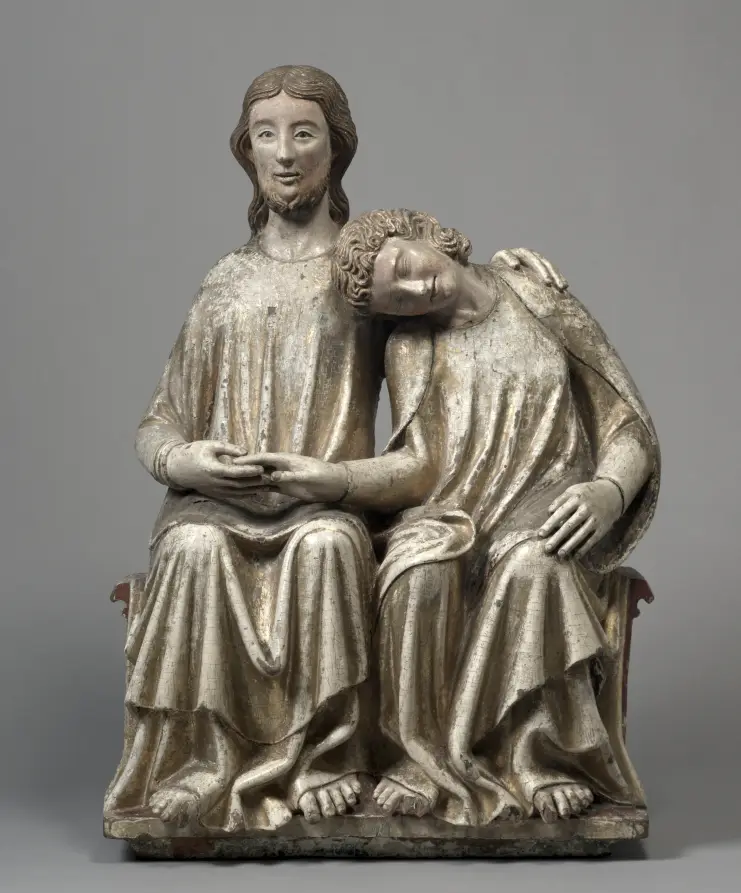
Christ and Saint John the Evangelist (1300–1320). Purchase from the J. H. Wade Fund Rights: CC0. https://clevelandart.org/art/1928.753
Vault de Lupin makes the source signal legible; it does not provide legal advice or replace the institution’s current rights statement.
From the museum record
This sculptural group featuring Saint John the Evangelist resting on the shoulder of Christ was a prolific subject in Swabia, the region on the Swiss border. The subject appears to be unique to this region, where it became popular in the years following 1300. Many of these devotional sculptures adorned the chapels of Dominican convents; this is artistically among the finest to survive. It captures the pathos of the moment, based on the Gospel of John (13:23), which states that during the Last Supper one of Christ’s disciples, namely "whom Jesus loved," was resting on his shoulder. As a focus for devotion and contemplation, this sculpture reflects the fundamental religious beliefs rooted in the mysticism that dominated the period. Mysticism was a movement that intended to stimulate the contemplation of Christ’s Passion and suffering. Mysticism encouraged private devotion and religious images, called andachtsbilder (devotional images), appeared in large numbers in late medieval Germany.
Lupin’s visual index
A silver-gilt sculpture depicts Christ seated with a mourner leaning upon his shoulder in a gesture of compassion.
Machine-assisted description · useful for discovery, not scholarship.