Vol. I · The open image paperWinnipeg · Musée sans mursRecovered · Remembered · Returned
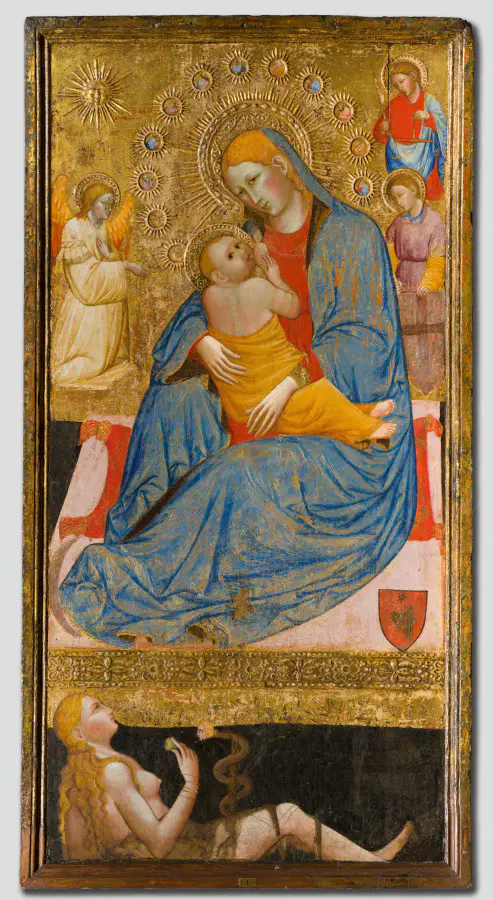
Cleveland Museum of Art97157portraitOlivuccio di Ciccarello (Italian, Marche, 1360/65–1439)c. 1400CC0cma sacred-art portraits objects-with-gravity sacred art objects with gravity madonna child virgin mary jesus angel renaissance italian art religious art gold leaf blue yellow portrait devotional panel medieval fresco the humility temptation eveOlivuccio di Ciccarello (Italian, Marche, 1360/65–1439) c. 1400 Italy, the Marches, late 14th-early 15th Century tempera and gold on wood panel Painting European ReligiousSacred & Devotional Faces in Time Objects with Gravity
Practical reuse
Use this artwork.
Verified CC0
This record carries an explicit open-use marker in the source metadata. Download the publication copy or follow the museum record for its master image.
The Madonna of Humility with the Temptation of Eve by Olivuccio di Ciccarello (Italian, Marche, 1360/65–1439) (c. 1400). Holden Collection Rights: CC0. https://clevelandart.org/art/1916.795
Vault de Lupin makes the source signal legible; it does not provide legal advice or replace the institution’s current rights statement.
From the museum record
The Madonna is seated humbly on the ground nursing her child. Saint George and the Archangels Gabriel and Michael kneel nearby, while Christ’s disciples appear radiating from the Madonna’s halo in the form of stars. In contrast with the Virgin’s purity, Eve lies in the lower part of the painting. Coaxed by the serpent, she raises the forbidden fruit to her mouth, thus condemning humankind through her original sin. The juxtaposition of these two images affirms the Incarnation and the role of Christ and the Virgin in the redemption story. The deep scratches on the surface of the panel, especially on the serpent’s face and Eve’s wrist, likely resulted from a zealous Christian’s symbolic attack on the power of evil. The artist, Olivuccio di Ciccarello, is known to have been active in the Marche in central Italy. Little is known of his life except that he was an important and prolific painter in Ancona, where he died. His paintings were formerly attributed to Carlo da Camerino, an apparently nonexistent artist, on the basis of a mistaken reading of his signature on a crucifix.
Lupin’s visual index
A vibrant depiction of the Virgin Mary holding the infant Jesus, surrounded by an angel in a richly detailed devotional panel.
Machine-assisted description · useful for discovery, not scholarship.
.webp)