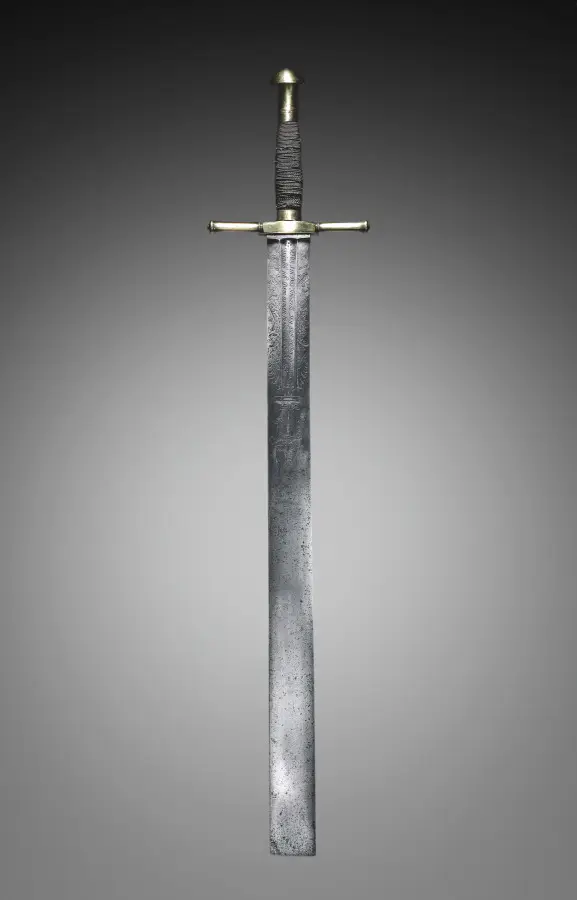
Executioner's Sword
Practical reuse

Use this artwork.

Verified CC0

This record carries an explicit open-use marker in the source metadata. Download the publication copy or follow the museum record for its master image.

Download publication WebP Open museum master ↗
Rights signal
CC0
Publication file
577 × 900 px · WebP
Suggested credit
Executioner's Sword (late 1600s). Gift of Mr. and Mrs. John L. Severance Rights: CC0. https://clevelandart.org/art/1916.1620

Vault de Lupin makes the source signal legible; it does not provide legal advice or replace the institution’s current rights statement.

From the museum record

Execution by decapitation was generally reserved for the nobility during the Middle Ages and Renaissance. Although the axe was favored in England, for centuries swords were used throughout Central Europe. The blades were often etched with moralizing inscriptions and designs representing Justice (as here), the gallows, the rack, or the Crucifixion. By the early 1700s swords were no longer primarily used in Europe for executions, but they still functioned as symbols of power. This sword was probably ceremonial for a formal procedure or procession.

Lupin’s visual index

A weathered, antique sword stands vertically against a dark gray background, showcasing its intricate metalwork and aged blade.

Machine-assisted description · useful for discovery, not scholarship.
Continue looking

Nearby in the vault.

Executioner's Sword

Executioner's Sword

Your private shortlist

Saved works 0

Stored only in this browser. No account, tracking, or upload.

No works saved yet.

Use “Save work” on any catalogue card or artwork record to build a working collection.