Practical reuse
Use this artwork.
Verified CC0 This record carries an explicit open-use marker in the source metadata. Download the publication copy or follow the museum record for its master image.
- Rights signal
- CC0
- Publication file
- 900 × 527 px · WebP
- Suggested credit
- Icon of the New Testament Trinity (c. 1450). Severance and Greta Millikin Trust Rights: CC0. https://clevelandart.org/art/2016.32
Vault de Lupin makes the source signal legible; it does not provide legal advice or replace the institution’s current rights statement.
From the museum record
This icon depicts an important subject in Orthodox Christian art, the three corresponding figures of the single godhead known as the Holy Trinity. The Trinity is represented here in a composition known as the “New Testament Trinity,” which features Christ and God the Father seated on a bench with a dove representing the Holy Spirit between them. The central field is occupied by a large wooden throne with gold highlights on which Christ (left) and the Ancient of the Days (God the Father as Christ in old age) are seated. The Holy Spirit, in the form of a dove, hovers within an eight-pointed star that signifies the eighth day, the future eon. On either side of the Trinity are two hymnographers, authors of hymns of praise, both identified by gold letters outlined in red—Saint Kosmas (about 675–752) on the left and Saint Joseph (about 812/818–about 886) on the right. They both suspend scrolls from round-arched windows. The icon likely was part of a church templon, the barrier that separated the nave from the sanctuary in an Orthodox church. It is not signed or dated; however, careful analysis of the painting’s style and technique places it in Constantinople around 1450, just prior to the city’s fall to the Ottomans in 1453. It represents a moment when Byzantine painting reached a brilliant crescendo.
Lupin’s visual index
This gilded icon depicts two bearded saints seated on a bench, surrounded by flanking icons and a radiant halo.
Machine-assisted description · useful for discovery, not scholarship. 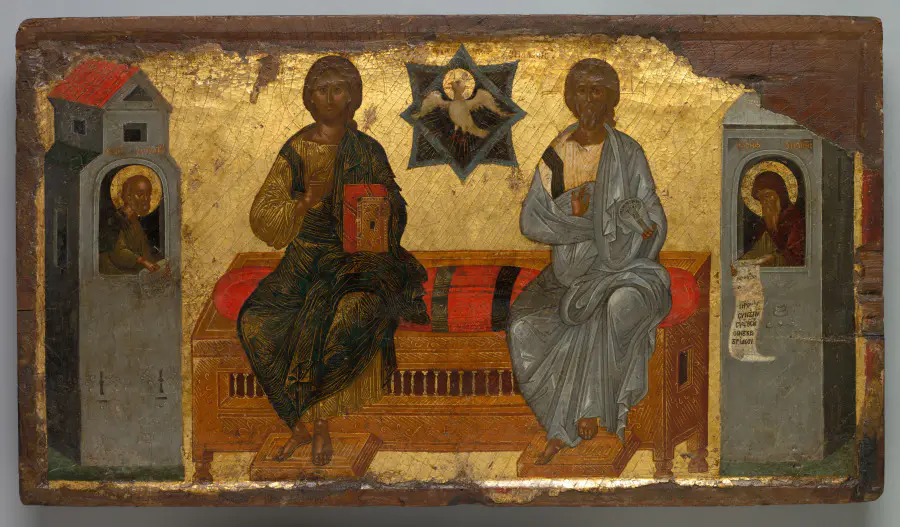
.webp)