Vol. I · The open image paperWinnipeg · Musée sans mursRecovered · Remembered · Returned
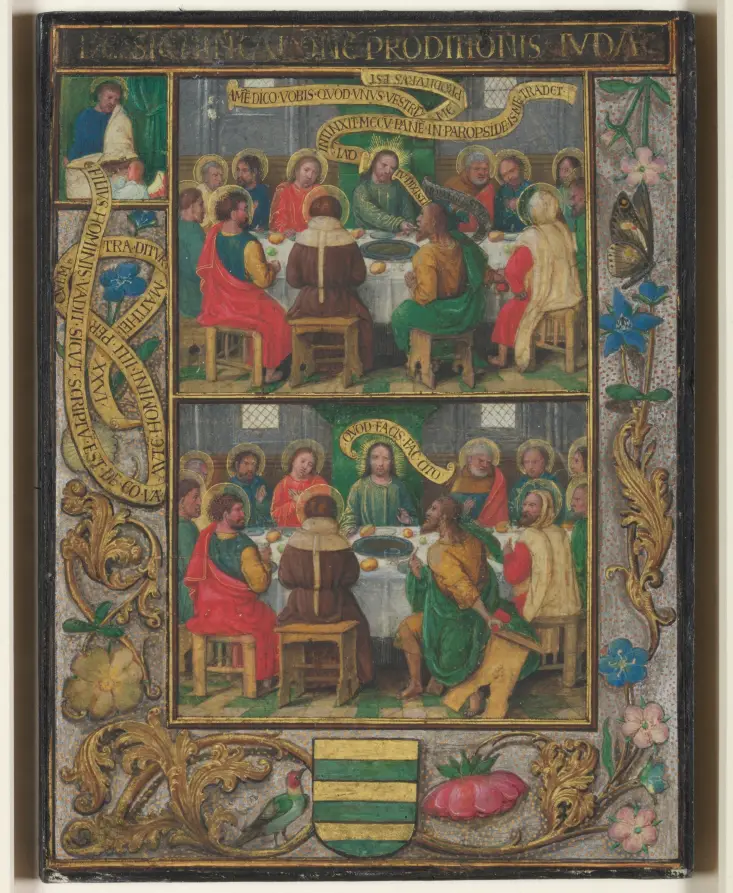
Cleveland Museum of Art162320portraitSimon Bening (Flemish, 1483–1561)c.1525–30CC0cma sacred-art portraits objects-with-gravity sacred art objects with gravity last supper jesus disciples religious art medieval painting oil painting italian renaissance table feast religious christian colors gold red blue detail single leaf scenes the last supperSimon Bening (Flemish, 1483–1561) c.1525–30 Flanders, Bruges tempera with liquid gold and silver on vellum, mounted on old wood board Manuscript European ReligiousSacred & Devotional Faces in Time Objects with Gravity
Practical reuse
Use this artwork.
Verified CC0
This record carries an explicit open-use marker in the source metadata. Download the publication copy or follow the museum record for its master image.
Single Leaf with Scenes from the Last Supper by Simon Bening (Flemish, 1483–1561) (c.1525–30). Gift of Bruce Ferrini, Pamela Ferrini, associates, and friends in memory of Matthew Ferrini Rights: CC0. https://clevelandart.org/art/2002.52
Vault de Lupin makes the source signal legible; it does not provide legal advice or replace the institution’s current rights statement.
From the museum record
Born either in Ghent or Antwerp in 1483, Simon Bening became one of the most famous manuscript painters of the 1500s. He was the son of the miniaturist Alexander Bening. His long career in Bruges, where he worked from 1508 until 1555, was distinguished by a series of major commissions for celebrated families. This illuminated leaf, one of 11 preserved from the now lost parent manuscript, was painted for a member of the important Spanish family of Enriquez de Ribera, whose coat of arms appears at the bottom of the miniature. The incident, shown in the upper register, during which Jesus gives a piece of bread to Judas (dressed in yellow and green) to indicate his knowledge of his betrayal, is depicted primarily according to the Gospel of John (13:21–30). In the lower register, Judas, realizing that his betrayal is understood, gets up suddenly to leave. His wooden stool topples over, and Christ’s words appear in a banderole: Quod facis fac cito ("What thou doest, do quickly," John 13:27). The two scenes are surrounded by an illusionistic border in liquid silver, with liquid gold acanthus, butterflies, and flowers. In the upper left of the border is the evangelist Matthew.
Lupin’s visual index
A vibrant depiction of the Last Supper shows Jesus and his disciples gathered around a table in a richly decorated room.
Machine-assisted description · useful for discovery, not scholarship.
.webp)