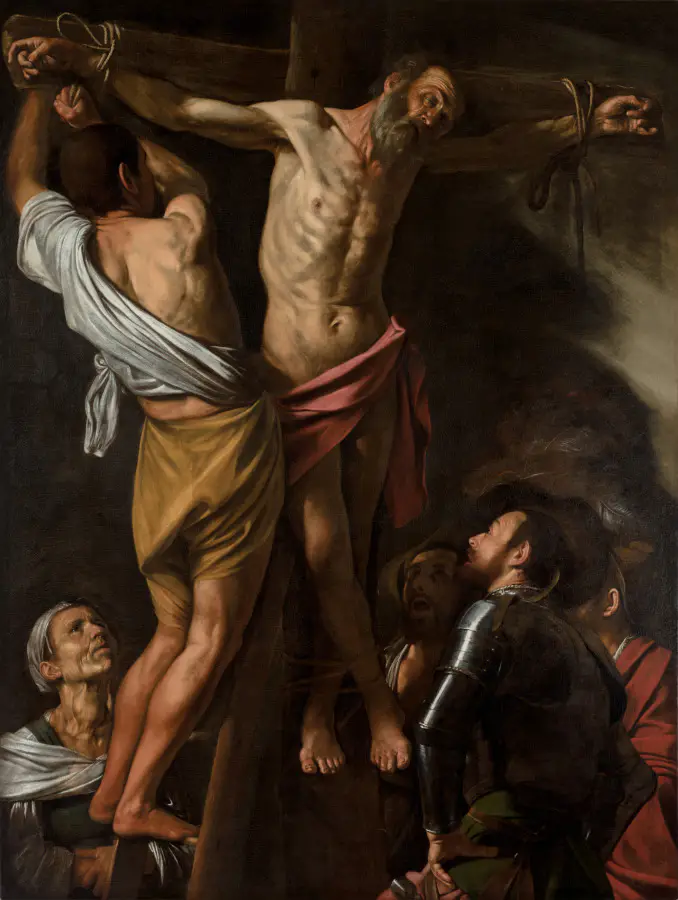
The Crucifixion of Saint Andrew
Practical reuse

Use this artwork.

Verified CC0

This record carries an explicit open-use marker in the source metadata. Download the publication copy or follow the museum record for its master image.

Download publication WebP Open museum master ↗
Rights signal
CC0
Publication file
678 × 900 px · WebP
Suggested credit
The Crucifixion of Saint Andrew by Caravaggio (Italian, 1571–1610) (1606–7). Leonard C. Hanna Jr. Fund Rights: CC0. https://clevelandart.org/art/1976.2

Vault de Lupin makes the source signal legible; it does not provide legal advice or replace the institution’s current rights statement.

From the museum record

Saint Andrew’s efforts to introduce Christianity to Greece in the first century CE were met with hostility from local authorities. He was sentenced to die on the cross because he refused to acknowledge pagan gods. For two days, Andrew preached from his martyr’s station to an increasingly sympathetic crowd. Bowing to public demand, Andrew’s would-be executioners attempted to untie him, but their hands were mysteriously paralyzed. Andrew’s desire for martyrdom was thus fulfilled and he died enveloped in divine light. Caravaggio’s innovative interpretation involves the viewer more closely in the event by presenting the crucifixion as intimate and private, rather than as a gruesome public spectacle. Bold contrasts of light and dark suggest the presence of God. A masterpiece of Baroque painting, Caravaggio’s Crucifixion of Saint Andrew is the only altarpiece by the artist in America.

Lupin’s visual index

a dramatic depiction of christ's crucifixion shows onlookers mourning his death in a dimly lit setting.

Machine-assisted description · useful for discovery, not scholarship.
Continue looking

Nearby in the vault.

The Crucifixion of Saint Andrew

The Crucifixion of Saint Andrew · Caravaggio (Italian, 1571–1610)

Your private shortlist

Saved works 0

Stored only in this browser. No account, tracking, or upload.

No works saved yet.

Use “Save work” on any catalogue card or artwork record to build a working collection.