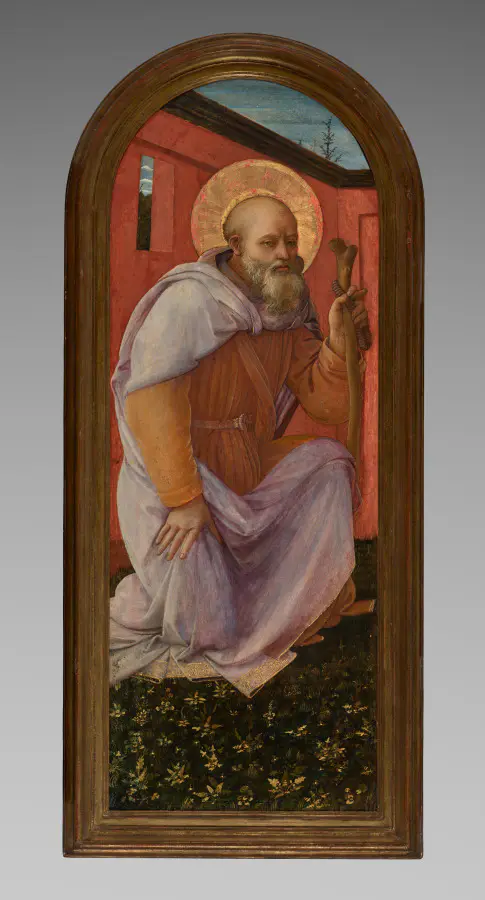
Panel from a Triptych: St. Anthony Abbot
Practical reuse

Use this artwork.

Verified CC0

This record carries an explicit open-use marker in the source metadata. Download the publication copy or follow the museum record for its master image.

Download publication WebP Open museum master ↗
Rights signal
CC0
Publication file
485 × 900 px · WebP
Suggested credit
Panel from a Triptych: St. Anthony Abbot by Fra Filippo Lippi (Italian, c. 1406–1469) (1458). Leonard C. Hanna Jr. Fund Rights: CC0. https://clevelandart.org/art/1964.150.2

Vault de Lupin makes the source signal legible; it does not provide legal advice or replace the institution’s current rights statement.

From the museum record

These panels depicting Saints Anthony the Abbot and Michael originally flanked a central scene of the Madonna and Child with Angels, now lost, to form a triptych. Giovanni di Cosimo de’Medici of Florence commissioned the ensemble in 1457 as a gift to Alfonso V of Aragon. Fra Filippo Lippi, a Carmelite friar and one of the great masters of early Renaissance Florence, depicted realistic, weighty figures in a three-dimensional space using a system of linear perspective, inspired partly by Masaccio’s Brancacci Chapel, and reflected in the background architecture. Saint Anthony the Abbot rejected all earthly possessions in pursuit of a contemplative life in the desert. He is generally regarded as the founder of monasticism and is depicted wearing a monk’s habit. Saint Michael’s sword and shield refer to his role as heaven’s defender against evil.

Lupin’s visual index

A kneeling Franciscan monk, depicted in rich colors, holds a book and appears in deep contemplation.

Machine-assisted description · useful for discovery, not scholarship.
Continue looking

Nearby in the vault.

Panel from a Triptych: St. Anthony Abbot

Panel from a Triptych: St. Anthony Abbot · Fra Filippo Lippi (Italian, c. 1406–1469)

Your private shortlist

Saved works 0

Stored only in this browser. No account, tracking, or upload.

No works saved yet.

Use “Save work” on any catalogue card or artwork record to build a working collection.