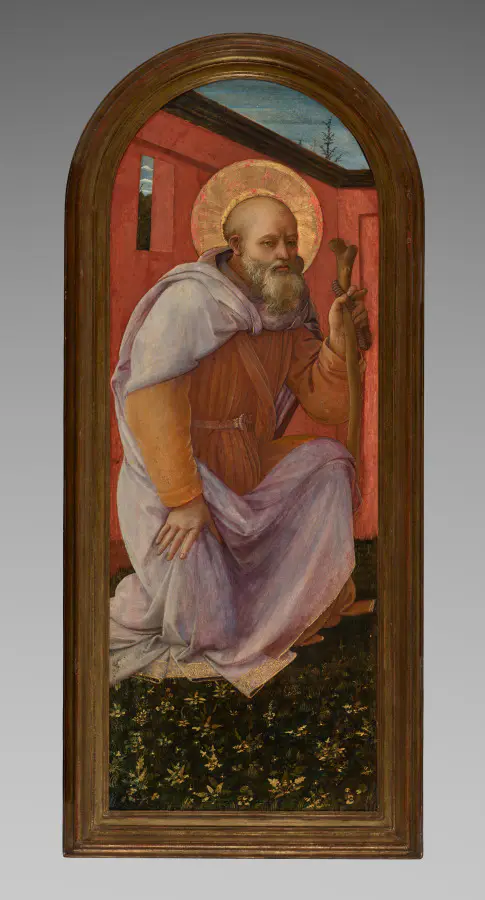
Panel from a Triptych: St. Anthony Abbot
Practical reuse

Use this artwork.

Verified CC0

This record carries an explicit CC0 marker in the source metadata. Download the publication copy or follow the source record for its master image.

Download publication WebP Open museum master ↗
Rights signal
CC0
Publication file
485 × 900 px · WebP
Suggested credit
Panel from a Triptych: St. Anthony Abbot by Fra Filippo Lippi (Italian, c. 1406–1469) (1458). Leonard C. Hanna Jr. Fund Rights: CC0. https://clevelandart.org/art/1964.150.2

Vault de Lupin makes the source signal legible; it does not provide legal advice or replace the institution’s current rights statement.

From the museum record

These panels depicting Saints Anthony the Abbot and Michael originally flanked a central scene of the Madonna and Child with Angels, now lost, to form a triptych. Giovanni di Cosimo de’Medici of Florence commissioned the ensemble in 1457 as a gift to Alfonso V of Aragon. Fra Filippo Lippi, a Carmelite friar and one of the great masters of early Renaissance Florence, depicted realistic, weighty figures in a three-dimensional space using a system of linear perspective, inspired partly by Masaccio’s Brancacci Chapel, and reflected in the background architecture. Saint Anthony the Abbot rejected all earthly possessions in pursuit of a contemplative life in the desert. He is generally regarded as the founder of monasticism and is depicted wearing a monk’s habit. Saint Michael’s sword and shield refer to his role as heaven’s defender against evil.

Lupin’s visual index

A kneeling Franciscan monk, depicted in rich colors, holds a book and appears in deep contemplation.

Machine-assisted description · useful for discovery, not scholarship.
Continue looking

Nearby in the vault.

Panel from a Triptych: St. Anthony Abbot

Panel from a Triptych: St. Anthony Abbot · Fra Filippo Lippi (Italian, c. 1406–1469)

Your private shortlist

Saved works 0

Stored only in this browser. No account, tracking, or upload.

No works saved yet.

Use “Save work” on any catalogue card or artwork record to build a working collection.