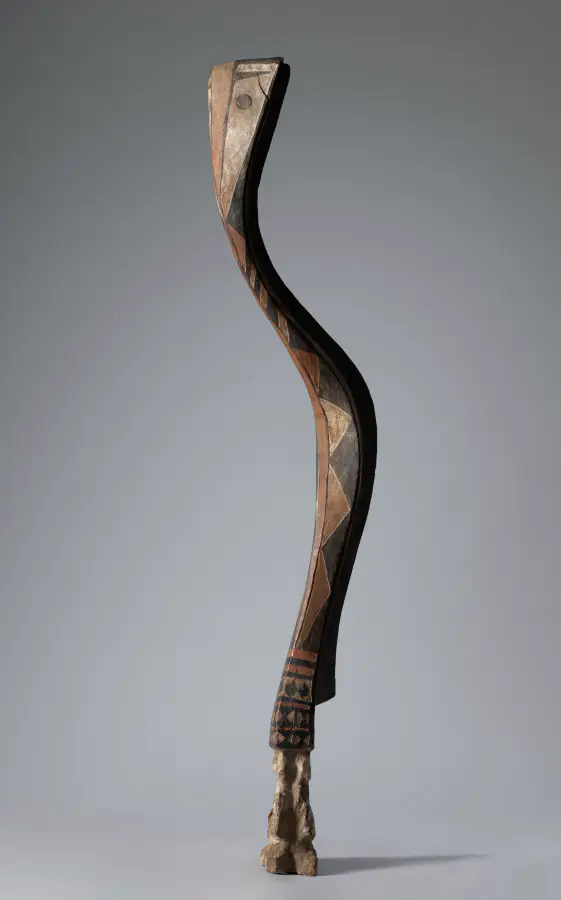
Serpent Headdress
Practical reuse

Use this artwork.

Verified CC0

This record carries an explicit open-use marker in the source metadata. Download the publication copy or follow the museum record for its master image.

Download publication WebP Open museum master ↗
Rights signal
CC0
Publication file
561 × 900 px · WebP
Suggested credit
Serpent Headdress (late 1800s–early 1900s). The Norweb Collection Rights: CC0. https://clevelandart.org/art/1960.37

Vault de Lupin makes the source signal legible; it does not provide legal advice or replace the institution’s current rights statement.

From the museum record

Nearly five feet tall, this serpent headdress towered above crowds when danced. Its two faces seemed to look in all directions. Secured by a conical framework of palm branches on a costumed man’s head, it appeared at key points in initiation rites for both boys and girls. This multi-colored snake may be the serpent-spirit Ninkinanka. It can be likened to the rainbow, whose changing colors evoke how boys transform into men during initiation. A staged circa 1954 photograph depicts the serpent headdress now at the CMA. Serpent masquerades stopped in the mid-1950s when most Nalu and Baga people converted to Islam.

Lupin’s visual index

A tall, stylized wooden sculpture depicts a sinuous serpent with geometric patterns and a textured surface.

Machine-assisted description · useful for discovery, not scholarship.
Continue looking

Nearby in the vault.

Serpent Headdress

Serpent Headdress

Your private shortlist

Saved works 0

Stored only in this browser. No account, tracking, or upload.

No works saved yet.

Use “Save work” on any catalogue card or artwork record to build a working collection.