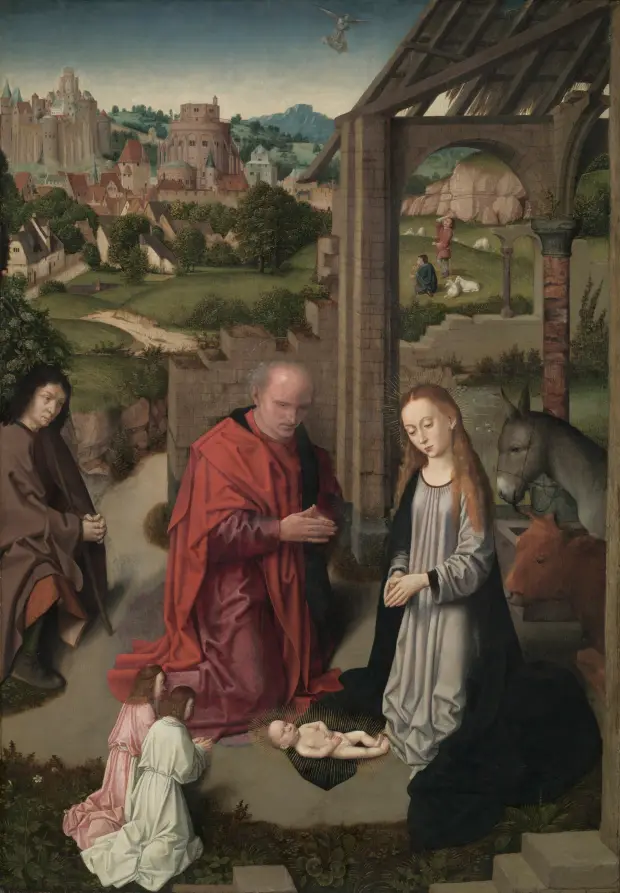
The Nativity
Practical reuse

Use this artwork.

Verified CC0

This record carries an explicit open-use marker in the source metadata. Download the publication copy or follow the museum record for its master image.

Download publication WebP Open museum master ↗
Rights signal
CC0
Publication file
620 × 893 px · WebP
Suggested credit
The Nativity by Gerard David (Netherlandish, 1450/60–1523) (c. 1485–90). Leonard C. Hanna Jr. Fund Rights: CC0. https://clevelandart.org/art/1958.320

Vault de Lupin makes the source signal legible; it does not provide legal advice or replace the institution’s current rights statement.

From the museum record

The nativity was one of the most frequently depicted subjects in western art. The event marks the entrance of Christ into the world and the fulfillment of Old Testament prophecy. In the distance an angel announces the birth of Christ to the shepherds tending their flocks. One shepherd is already at the stable adoring the Christ child. In the background, the cityscape represents Jerusalem, where Christ would be crucified, represented here as a northern medieval city. Only Matthew and Luke describe Christ’s nativity in the Gospels, which led medieval writers and artists to amplify the event. Some scholars have suggested that the head of Joseph is a donor portrait. Gerard David was born in Oudewater, now located in Utrecht. He spent his mature career in Bruges, where he was a member of the painters’ guild. Upon the death of Hans Memling in 1494, David became Bruges’s leading painter of devotional panels. He was also a manuscript illuminator.

Lupin’s visual index

A richly detailed oil painting depicts the presentation of Jesus at the temple, showcasing a solemn and contemplative scene.

Machine-assisted description · useful for discovery, not scholarship.
Continue looking

Nearby in the vault.

The Nativity

The Nativity · Gerard David (Netherlandish, 1450/60–1523)

Your private shortlist

Saved works 0

Stored only in this browser. No account, tracking, or upload.

No works saved yet.

Use “Save work” on any catalogue card or artwork record to build a working collection.