Practical reuse
Use this artwork.
Verified CC0 This record carries an explicit open-use marker in the source metadata. Download the publication copy or follow the museum record for its master image.
- Rights signal
- CC0
- Publication file
- 1263 × 830 px · WebP
- Suggested credit
- Head of Saint John the Baptist (c. 1550–1650). Mr. and Mrs. William H. Marlatt Fund Rights: CC0. https://clevelandart.org/art/1953.424
Vault de Lupin makes the source signal legible; it does not provide legal advice or replace the institution’s current rights statement.
From the museum record
Salome’s dancing so pleased her stepfather Herod that he offered her anything she wanted. Her mother advised Salome to demand John the Baptist’s head, which Salome presented to her family in an elaborate dish. Here, the head stands on its own, with a startlingly tangible presence. Despite its biblical source, this work was meant for a domestic setting, whose owner would have admired the artful presentation of a shocking story. Acquired in 1953 as the work of the Venetian Renaissance artist Titian, the painting soon lost this attribution because it lacks Titian’s distinctive brushwork. After decades of research, the museum has yet to identify a clear author. Recently, several scholars have argued persuasively for a Spanish artist, partly because the subject is common in Spanish art in the early 1600s. Yet the color scheme and the handling of paint in the face recalls the work of earlier artists inspired by Titian in northern Italy.
Lupin’s visual index
A dramatically lit oil painting depicts a man's severed head emerging from a shallow, blood-stained basin.
Machine-assisted description · useful for discovery, not scholarship. 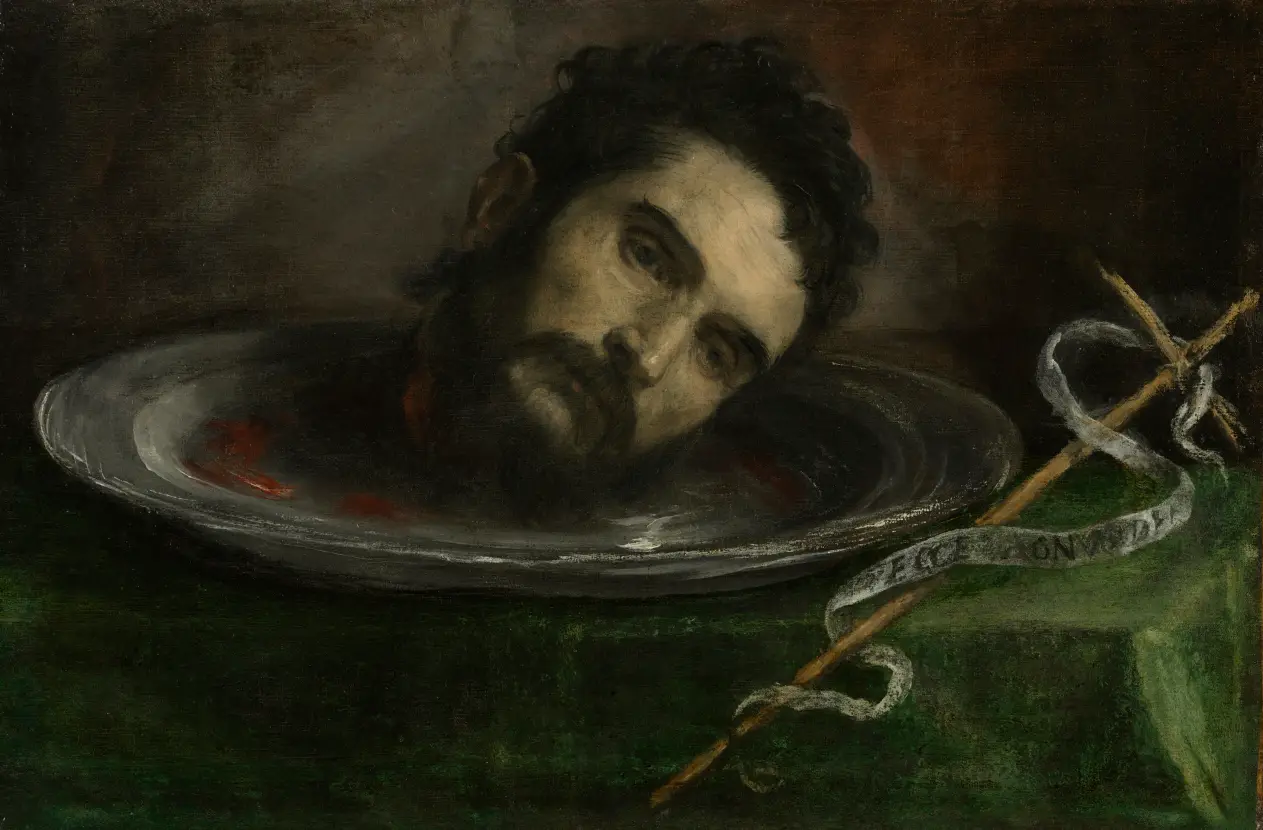
.webp)