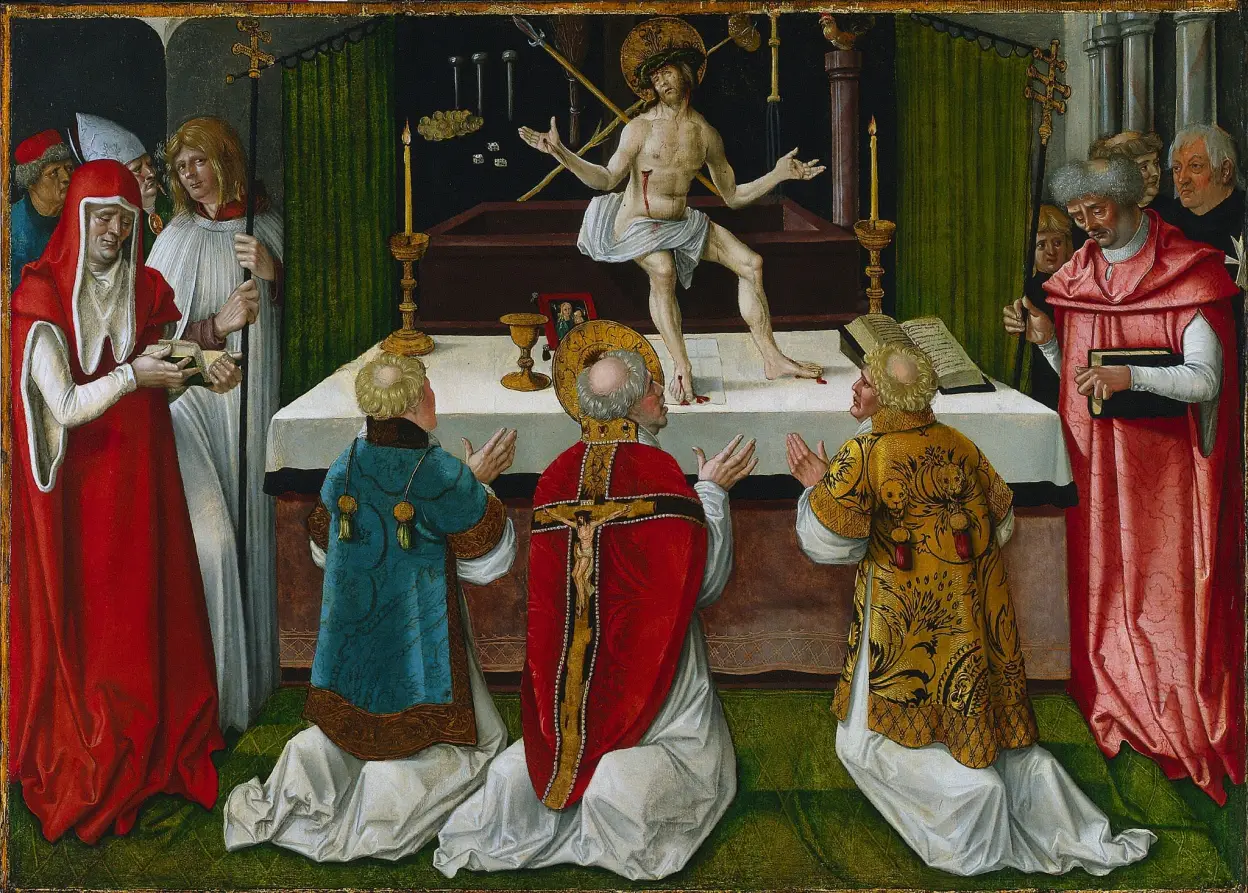
The Mass of Saint Gregory
Practical reuse

Use this artwork.

Verified CC0

This record carries an explicit open-use marker in the source metadata. Download the publication copy or follow the museum record for its master image.

Download publication WebP Open museum master ↗
Rights signal
CC0
Publication file
1248 × 893 px · WebP
Suggested credit
The Mass of Saint Gregory by Hans Baldung (German, 1484/85–1545) (1511). Gift of the Hanna Fund Rights: CC0. https://clevelandart.org/art/1952.112

Vault de Lupin makes the source signal legible; it does not provide legal advice or replace the institution’s current rights statement.

From the museum record

Saint Gregory was a late 6th-century pope and one of the fathers of the early Roman Church. This painting depicts the popular legend in which Gregory once overheard an onlooker express doubts about Christ’s actual presence at the altar during mass. In response, the saint’s immense faith was rewarded by a vision of Christ surrounded by the instruments and symbols of his passion. Saint Gregory, vested in his chasuble, kneels in the center, flanked by priests who share his amazement. This painting was part of an altarpiece commissioned by Erhard Künig, a member of a charitable lay order for a monastery near Strassburg. Künig stands at the far right wearing a Maltese cross. The two wings of the altar, showing respectively Saint John the Evangelist and Saint John the Baptist, are in New York and Washington. Hans Baldung was both a painter and a printmaker and is regarded as one of the most gifted students of Albrecht Dürer.

Lupin’s visual index

A group of clergy and religious figures kneel in prayer before the lifeless body of Christ, displayed on a stone altar.

Machine-assisted description · useful for discovery, not scholarship.
Continue looking

Nearby in the vault.

The Mass of Saint Gregory

The Mass of Saint Gregory · Hans Baldung (German, 1484/85–1545)

Your private shortlist

Saved works 0

Stored only in this browser. No account, tracking, or upload.

No works saved yet.

Use “Save work” on any catalogue card or artwork record to build a working collection.