Chasse
Practical reuse

Use this artwork.

Verified CC0

This record carries an explicit open-use marker in the source metadata. Download the publication copy or follow the museum record for its master image.

Download publication WebP Open museum master ↗
Rights signal
CC0
Publication file
900 × 760 px · WebP
Suggested credit
Chasse (c. 1225–50). Gift of S. Livingstone Mather, Constance Mather Bishop, Philip R. Mather, Katherine Hoyt Cross, and Katherine Mather McLean in accordance with the wishes of Samuel Mather Rights: CC0. https://clevelandart.org/art/1940.347

Vault de Lupin makes the source signal legible; it does not provide legal advice or replace the institution’s current rights statement.

From the museum record

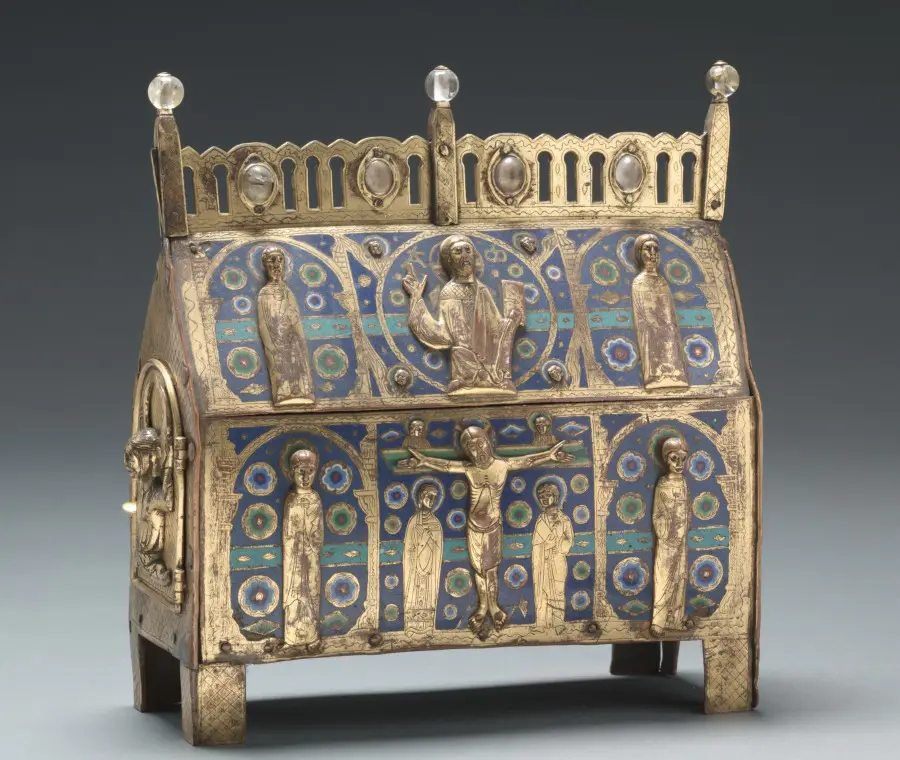
A chasse is a container with a pyramid-shaped roof that once served as a shrine for sacred relics. During the medieval period, chasses like this one were placed on church altars during high feast days to allow the faithful to venerate their sacred contents. The chasse’s design and imagery follow a common formula with Christ’s Crucifixion and Majesty decorating the central fields of its principal face. The back consists of two panels with identical decoration. Each features three busts of angels inscribed in medallions. Of the chasse’s lateral sides, only one is preserved in its original state, decorated with the figure of an imposing angel emerging from a bank of clouds. Here, the dark blue enamel background shows an even greater variety of rosettes and other decorative motifs, all engraved, stippled, and gilded like the ones on the other sides

Lupin’s visual index

This intricately decorated casket showcases gold overlay and enamel detailing depicting biblical figures and geometric patterns.

Machine-assisted description · useful for discovery, not scholarship.
Continue looking

Nearby in the vault.

Chasse

Chasse

Your private shortlist

Saved works 0

Stored only in this browser. No account, tracking, or upload.

No works saved yet.

Use “Save work” on any catalogue card or artwork record to build a working collection.